- Added validation for `PluginTriggerData` and `ScheduleTriggerData` in the `WorkflowService` to support new trigger types.
- Updated debug event return strings in `PluginTriggerDebugEvent` and `WebhookDebugEvent` for clarity and consistency.
- Enhanced logging in `dispatch_triggered_workflows_async` to include subscription and provider IDs, improving traceability during trigger dispatching.
- Changed the description field type in `TriggerApiEntity` from `TriggerDescription` to `TypeWithI18N` for improved internationalization support.
- Adjusted the usage of the description field in the `convertToTriggerWithProvider` function to align with the new type definition.
- Changed `TriggerApiEntity` to `EventApiEntity` in the trigger provider and subscription models to better reflect its purpose.
- Updated the description field type from `EventDescription` to `I18nObject` for improved consistency in event descriptions.
- Adjusted imports and references across multiple files to accommodate the renaming and type changes, ensuring proper functionality in trigger processing.
- Updated the `AppDslService` to clear the `subscription_id` when processing nodes of type `TRIGGER_PLUGIN`. This change ensures that sensitive subscription data is not retained unnecessarily, enhancing data security during workflow execution.
- Added functionality to decrypt subscription credentials and properties within the `dispatch_triggered_workflows_async` method. This ensures that sensitive data is securely handled before processing, improving the overall security of trigger invocations.
- Updated the `PluginTriggerManager` to serialize the `subscription` parameter using `model_dump()` before passing it during trigger invocation. This change ensures that the subscription data is correctly formatted for processing.
- Enhanced `PluginTriggerManager`, `PluginTriggerProviderController`, and `TriggerManager` to accept a `subscription` parameter in their trigger invocation methods.
- Updated `TriggerService` to pass the subscription entity when invoking trigger events, improving the handling of subscription-related data during trigger execution.
Critical regression fix for convertTimezoneToOffsetStr:
Issues Fixed:
- Previous regex /^([+-]?\d{1,2}):00/ only matched :00 offsets
- This caused half-hour offsets (e.g., India +05:30) to return UTC+0
- Even if matched, parseInt only parsed hours, losing minute info
Changes:
- Update regex to /^([+-]?\d{1,2}):(\d{2})/ to match all offset formats
- Parse both hours and minutes separately
- Output format: "UTC+5:30" for non-zero minutes, "UTC+8" for whole hours
- Preserve leading zeros in minute part (e.g., "UTC+5:30" not "UTC+5:3")
Test Coverage:
- Added 8 comprehensive tests covering:
* Default/invalid timezone handling
* Whole hour offsets (positive/negative)
* Zero offset (UTC)
* Half-hour offsets (India +5:30, Australia +9:30)
* 45-minute offset (Chatham +12:45)
* Leading zero preservation in minutes
All 14 tests passing. Verified with timezone.json entries at lines 967, 1135, 1251.
- Change layout to ensure timezone label always visible with shrink-0
- Time text can truncate but timezone label stays intact
- Improves readability in constrained node space
- Add showTimezone prop to TimePickerProps for optional inline timezone display
- Integrate TimezoneLabel component into TimePicker when showTimezone=true
- Add 6 comprehensive test cases covering all showTimezone scenarios:
* Default behavior (no timezone label)
* Explicit disable with showTimezone=false
* Enable with showTimezone=true
* Inline prop correctly passed
* No display when timezone is missing
* Correct styling classes applied
- Update trigger-schedule panel to use showTimezone prop
- All 15 tests passing with good coverage
- Fixed convertTimezoneToOffsetStr() that only extracted first digit
* UTC-11 was incorrectly displayed as UTC-1, UTC+10 as UTC+0
* Now correctly extracts full offset using regex and removes leading zeros
- Created reusable TimezoneLabel component with inline mode support
- Added comprehensive unit tests with 100% coverage
- Integrated timezone labels into 3 locations:
* Panel time picker (next to time input)
* Node next execution display
* Panel next 5 executions list
- Introduced `TriggerProviderIconApi` to fetch icons for trigger plugins based on tenant and provider ID.
- Updated `WorkflowResponseConverter` to include trigger plugin icons in the response.
- Implemented `get_trigger_plugin_icon` method in `TriggerManager` for icon retrieval logic.
- Adjusted `Node` class to correctly set provider information for trigger plugins.
- Modified TypeScript types to accommodate new provider ID field in workflow nodes.
- Introduced a subscriptionCount variable to improve readability and performance when checking the number of subscriptions.
- Updated the rendering logic to use subscriptionCount, ensuring consistent and clear display of subscription information in the component.
- Replaced direct length checks on subscriptions with a computed subscriptionCount variable for improved readability and performance.
- Updated the CreateSubscriptionButton to conditionally render based on the new subscriptionCount variable, enhancing clarity in the component logic.
- Adjusted className logic for the button to account for multiple supported methods, ensuring better user experience.
- Introduced atomic operations for updating and verifying subscription builders to prevent race conditions.
- Added distributed locking mechanism to ensure data consistency during concurrent updates and builds.
- Refactored existing methods to utilize the new atomic update and verification logic, enhancing the reliability of trigger subscription handling.
- Updated the trigger subscription query to join with the AppTrigger model, ensuring only enabled app triggers are considered.
- Enhanced the filtering criteria for retrieving subscribers based on the AppTrigger status, improving the accuracy of the trigger subscription handling.
- Removed the redundant response extraction from the dispatch call and directly assigned the response to a variable for clarity.
- Enhanced logging by appending the request log after dispatching, ensuring better traceability of requests and responses in the trigger subscription workflow.
- Wrapped the dispatch call in a try-except block to catch exceptions and return a 500 error response if an error occurs.
- Enhanced logging of the request and error response for better traceability in the trigger subscription workflow.
- Added `credentials` and `credential_type` parameters to various methods in `PluginTriggerManager`, `PluginTriggerProviderController`, and `TriggerManager` to support improved credential management for trigger subscriptions.
- Updated the `Subscription` model to include `parameters` for better subscription data handling.
- Refactored related services to accommodate the new credential handling, ensuring consistency across the trigger workflow.
- Changed the parameter name from 'type' to 'type_' in multiple method calls within the PluginTriggerManager class to avoid conflicts with the built-in type function and improve code clarity.
- Cleaned up the code by removing extraneous whitespace in `trigger.py` and `workflow_plugin_trigger_service.py`, improving readability and maintaining code style consistency.
- Modified the build-push workflow to trigger on all branches under "deploy/**" for broader deployment coverage.
- Changed the SSH host secret in the deploy-dev workflow from RAG_SSH_HOST to DEV_SSH_HOST for improved clarity.
- Removed the obsolete deploy-rag-dev workflow to streamline the CI/CD process.
- Updated the naming convention from 'trigger_name' to 'event_name' across various models and services to align with the new event-driven architecture.
- Refactored methods in PluginTriggerManager and PluginTriggerProviderController to use 'invoke_trigger_event' instead of 'invoke_trigger'.
- Adjusted database migration scripts to reflect changes in the schema, including the addition of 'event_name' and 'subscription_id' fields in the workflow_plugin_triggers table.
- Removed deprecated trigger-related methods in WorkflowPluginTriggerService to streamline the codebase.
- Changed the route from "/apps/<uuid:app_id>/workflows/draft/trigger/run" to "/apps/<uuid:app_id>/workflows/draft/trigger/plugin/run" to reflect the new plugin-based trigger structure.
- Updated corresponding URL in the useWorkflowRun hook to maintain consistency across the application.
- Renamed 'trigger_name' to 'event_name' in the DraftWorkflowTriggerNodeApi for consistency with the new naming convention.
- Added 'provider_id' to the API request model to enhance functionality.
- Updated the PluginTriggerDebugEvent and TriggerDebugService to reflect changes in naming and improve address formatting.
- Adjusted frontend utility to align with the updated variable names.
- Updated the `update` method in `SubscriptionBuilderUpdater` to use 'is not None' checks instead of truthy evaluations for better handling of empty values.
- This change improves clarity and ensures that empty dictionaries or strings are correctly processed during updates.
- Renamed variables related to triggers to use 'trigger' terminology consistently across the codebase.
- Adjusted filtering logic in `TriggerPluginList` to reference 'events' instead of 'triggers' for improved clarity.
- Updated the `getTriggerIcon` function to reflect the new naming conventions and ensure proper icon rendering.
- Updated variable names and types from 'trigger' to 'event' across multiple files to enhance clarity and maintain consistency in the codebase.
- Adjusted related data structures and API responses to reflect the new naming convention.
- Improved type annotations and error handling in the workflow trigger run API and associated services.
- Introduced a base class for debug events to streamline event handling.
- Refactored `TriggerDebugService` to support multiple event types through a generic dispatch/poll interface.
- Updated webhook and plugin trigger debug services to utilize the new event structure.
- Enhanced the dispatch logic in `dispatch_triggered_workflows_async` to accommodate the new event model.
- Update TriggerProviderApiEntity type to use events field (aligned with backend commit 32f4d1af8)
- Update conversion function in use-triggers.ts to map provider.events to TriggerWithProvider.triggers
- Fix trigger-events-list.tsx to use providerInfo.events (TriggerProviderApiEntity type)
- Fix parameters-form.tsx to use provider.triggers (TriggerWithProvider type)
- Updated class and variable names from 'triggers' to 'events' across multiple files to improve clarity and consistency.
- Adjusted related data structures and methods to reflect the new naming convention, including changes in API entities, service methods, and trigger management logic.
- Ensured all references to triggers are replaced with events to align with the updated terminology.
- Add ENTRY_NODE_WRAPPER_OFFSET constant (x: 0, y: 21) for Start/Trigger nodes
- Implement getNodeAlignPosition() to calculate actual inner node positions
- Fix horizontal/vertical helpline rendering to account for wrapper offset
- Fix snap-to-align logic to properly align inner nodes instead of wrapper
- Correct helpline width/height calculation by subtracting offset for entry nodes
- Ensure backward compatibility: only affects Start/Trigger nodes with EntryNodeContainer wrapper
This fix ensures that Start and Trigger nodes (which have an EntryNodeContainer wrapper
with status indicator) align based on their inner node boundaries rather than the wrapper
boundaries, matching the alignment behavior of regular nodes.
- Replaced SubscriptionSchema with SubscriptionConstructor in various parts of the trigger provider implementation to streamline subscription management.
- Enhanced the PluginTriggerProviderController to utilize the new subscription constructor for retrieving default properties and credential schemas.
- Removed the deprecated get_provider_subscription_schema method from TriggerManager.
- Updated TriggerSubscriptionBuilderService to reflect changes in subscription handling, ensuring compatibility with the new structure.
These changes improve the clarity and maintainability of the subscription handling within the trigger provider architecture.
- Updated the llm_description assignment in the ToolParameter to safely access the en_US property of paramDescription, ensuring it defaults to an empty string if not present. This change improves the robustness of the parameter handling in the plugin detail panel.
- Introduced CHECKBOX as a new parameter type in CommonParameterType and PluginParameterType.
- Updated as_normal_type and cast_parameter_value functions to handle CHECKBOX type.
- Enhanced ToolParameter class to include CHECKBOX for consistency across parameter types.
These changes expand the parameter capabilities within the API, allowing for more versatile input options.
- Removed unnecessary ValueError handling in TriggerSubscriptionBuilderCreateApi and TriggerSubscriptionBuilderBuildApi, allowing for more streamlined exception management.
- Updated TriggerSubscriptionBuilderVerifyApi and TriggerSubscriptionBuilderBuildApi to raise ValueError with the original exception context for better debugging.
- Enhanced trigger_endpoint in trigger.py to log errors and return a JSON response for not found endpoints, improving user feedback and error reporting.
These changes enhance the robustness and clarity of error handling across the API.
- Refactor TriggerEventsList component to utilize provider information for dynamic tool rendering.
- Implement locale-aware text handling for trigger descriptions and labels.
- Introduce utility functions for better management of tool parameters and trigger descriptions.
- Improve user experience by ensuring consistent display of trigger events based on available provider data.
This update enhances the functionality and maintainability of the trigger events list, aligning with the project's metadata-driven approach.
- Add isStart: true to all trigger nodes (TriggerWebhook, TriggerSchedule, TriggerPlugin)
- Replace hardcoded BlockEnum checks in use-checklist.ts with metadata-driven logic
- Update trigger node tests to validate metadata instead of obsolete methods
- Add webhook URL validation to TriggerWebhook node
- Ensure backward compatibility with existing workflow configurations
This change migrates from hardcoded trigger node identification to a
centralized metadata-driven approach, improving maintainability and
consistency across the workflow system.
This comprehensive restore includes:
## Test Run System Restoration
- Restore test-run-menu.tsx component with multi-trigger support and keyboard shortcuts
- Restore use-dynamic-test-run-options.tsx hook for dynamic trigger option generation
- Restore workflow-entry.ts utilities for entry node detection and validation
- Integrate complete test run functionality back into run-mode.tsx
## Block Selector System Fixes
- Fix workflow block selector constants by uncommenting BLOCKS and START_BLOCKS arrays
- Restore proper i18n translations for trigger node descriptions using workflow.blocksAbout keys
- Filter trigger types from Blocks tab to prevent duplication with Start tab
- Fix trigger node handle display to match start node behavior (hide left input handles)
## Workflow Validation System Improvements
- Restore unified workflow validation using correct getValidTreeNodes(nodes, edges) signature
- Remove duplicate Start node validation from isRequired mechanism
- Eliminate "user input must be added" validation error by setting Start node isRequired: false
- Fix end node connectivity validation to properly detect valid workflow chains
## Component Integration
- Verify all dependencies exist (TriggerAll icon, useAllTriggerPlugins hook)
- Maintain keyboard shortcut integration (Alt+R, ~, 0-9 keys)
- Preserve portal-based dropdown positioning and tooltip structure
- Support multiple trigger types: user_input, schedule, webhook, plugin, all
This restores the complete test run functionality that was missing from feat/trigger branch
by systematically analyzing and restoring components from feat/trigger-backup-before-merge.
- Set Start node isRequired: false since entry node validation is handled by unified logic
- Remove conditional skip logic in checklist since Start is no longer in isRequiredNodesType
- Cleaner separation of concerns: unified entry node check vs individual required nodes
- Eliminates architectural inconsistency where Start was both individually required and part of group validation
- Skip Start node requirement in isRequiredNodesType loop since it's already covered by unified entry node validation
- Eliminates duplicate 'User Input must be added' error when trigger nodes are present
- Both useChecklist and useChecklistBeforePublish now consistently handle entry node validation
- Resolves UI showing redundant validation errors for Start vs Trigger nodes
- Extend handle hiding logic to include TriggerWebhook, TriggerSchedule, TriggerPlugin
- Make trigger nodes behave like Start nodes without left-side input handles
- Apply fix to both main workflow and preview node handle components
- Ensures consistent UX where all start-type nodes have no input handles
- Fix trigger tooltip descriptions to use workflow.blocksAbout translations
- Filter TriggerWebhook/TriggerSchedule/TriggerPlugin from Blocks component
- Ensure trigger types only appear in Start tab, not Nodes tab
Removes explicit Start node exclusion from handleNodesDelete function:
- Remove BlockEnum.Start filter from bundled nodes selection
- Remove BlockEnum.Start filter from selected node detection
- Allows DEL/Backspace keys to delete Start nodes same as other nodes
- Button delete already worked, now keyboard delete works too
Fixes: Start nodes can now be deleted via both button and keyboard shortcuts
🤖 Generated with [Claude Code](https://claude.ai/code)
Co-Authored-By: Claude <noreply@anthropic.com>
Complete workflow liberalization following PR #24627:
1. Remove Start node deletion restriction by removing isUndeletable property
2. Fix draft sync blocking when no Start node exists
3. Restore isWorkflowDataLoaded protection to prevent race conditions
4. Ensure all entry nodes (Start + 3 trigger types) have equal deletion rights
This allows workflows with only trigger nodes and fixes the issue where
added nodes would disappear after page refresh due to sync API blocking.
🤖 Generated with [Claude Code](https://claude.ai/code)
Co-Authored-By: Claude <noreply@anthropic.com>
- Initialized `response` variable in `trigger.py` to ensure proper handling in the trigger endpoint.
- Updated `http_parser.py` to conditionally set `CONTENT_TYPE` and `CONTENT_LENGTH` headers for improved robustness.
- Changed `datetime.utcnow()` to `datetime.now(UTC)` in `sqlalchemy_workflow_trigger_log_repository.py` and `rate_limiter.py` for consistent time zone handling.
- Refactored `async_workflow_service.py` to use the public method `get_tenant_owner_timezone` for better encapsulation.
- Simplified subscription retrieval logic in `plugin_parameter_service.py` for clarity.
These changes improve code reliability and maintainability while ensuring accurate time management and request processing.
- Replaced `is_editor` checks with `has_edit_permission` in `workflow_trigger.py` and `workflow.py` to enhance clarity and consistency in permission handling.
- Updated the rate limiter to use `datetime.now(UTC)` instead of `datetime.utcnow()` for accurate time handling.
- Added `__all__` declaration in `trigger/__init__.py` for better module export management.
- Initialized `debug_dispatched` variable in `trigger_processing_tasks.py` to ensure proper tracking during workflow dispatching.
These changes improve code readability and maintainability while ensuring correct permission checks and time management.
- Removed the `PluginTriggerApi` resource route from `workflow_trigger.py` to streamline the API and improve maintainability. This change contributes to a cleaner and more organized codebase.
- Replaced direct imports of `TriggerProviderID` and `ToolProviderID` from `core.plugin.entities.plugin` with imports from `models.provider_ids` for better organization.
- Refactored workflow node classes to inherit from a unified `Node` class, improving consistency and maintainability.
- Removed unused code and comments to clean up the implementation, particularly in the `workflow_trigger.py` and `builtin_tools_manage_service.py` files.
These changes enhance the clarity and structure of the codebase, facilitating easier future modifications.
Fixed the issue that filename will be 'inline' if response header contains `Content-Disposition: inline` while retrieving file by url.
Co-authored-by: crazywoola <100913391+crazywoola@users.noreply.github.com>
Co-authored-by: autofix-ci[bot] <114827586+autofix-ci[bot]@users.noreply.github.com>
- Added `TriggerInvokeError` and `TriggerIgnoreEventError` for better error categorization during trigger invocation.
- Updated `TriggerInvokeResponse` to include a `cancelled` field, indicating if a trigger was ignored.
- Enhanced `TriggerManager` to handle specific errors and return appropriate responses.
- Refactored `dispatch_triggered_workflows` to improve workflow execution logic and error handling.
These changes improve the robustness and clarity of the trigger management system.
- Renamed validation-related constants to builder-related ones for clarity.
- Updated cache expiration from milliseconds to seconds for consistency.
- Adjusted log key format to reflect the builder context instead of validation.
These changes enhance the readability and maintainability of the TriggerSubscriptionBuilderService.
- Changed the cache key format in the `encode_cache_key` method from `trigger:subscription:validation:{subscription_id}` to `trigger:subscription:builder:{subscription_id}` to better reflect its purpose.
This update improves clarity in cache key usage for trigger subscriptions.
Fixes#25619
The regex patterns for file-preview and image-preview contained an unescaped `?`,
which caused incorrect matches such as `file-previe` or `image-previw`.
This led to malformed URLs being incorrectly re-signed.
Changes:
- Escape `?` in both file-preview and image-preview regex patterns.
- Ensure only valid URLs are re-signed.
Added unit tests to cover:
- Valid file-preview and image-preview URLs (correctly re-signed).
- Misspelled file/image preview URLs (no longer incorrectly matched).
Other:
- Fix a deprecated function `datetime.utcnow()`
Co-authored-by: autofix-ci[bot] <114827586+autofix-ci[bot]@users.noreply.github.com>
Co-authored-by: Asuka Minato <i@asukaminato.eu.org>
Co-authored-by: crazywoola <100913391+crazywoola@users.noreply.github.com>
- Introduced a new field `multiple` in the `ProviderConfig` class to allow for multiple selections, enhancing the configuration capabilities for providers.
- This addition improves flexibility in provider settings and aligns with the evolving requirements for provider configurations.
- Replaced calls to `create_trigger_provider_encrypter` and `create_trigger_provider_oauth_encrypter` with a unified `create_provider_encrypter` method, simplifying the encrypter creation process.
- Updated the parameters passed to the new method to enhance configuration management and cache handling.
These changes improve code clarity and maintainability in the trigger provider service.
- Modified the `create_provider_encrypter` call to include a cache assignment, ensuring proper management of encryption resources.
- Added a cache deletion step after updating client parameters, enhancing the integrity of the parameter handling process.
These changes improve the reliability of client parameter updates within the trigger provider service.
- Changed session management in `TriggerProviderService` from `autoflush=True` to `expire_on_commit=False` for improved control over session state.
- This change enhances the reliability of database interactions by preventing automatic expiration of objects after commit, ensuring data consistency during trigger operations.
These updates contribute to better session handling and stability in trigger-related functionalities.
- Introduced `TriggerProviderInfoApi` to retrieve information for a specific trigger provider, improving API capabilities.
- Added `get_trigger_provider` method in `TriggerProviderService` to fetch trigger provider details, enhancing data retrieval.
- Updated route configurations to include the new API endpoint for trigger provider information.
These changes enhance the functionality and usability of trigger provider interactions within the application.
- Added `plugin_unique_identifier` to `PluginTriggerData` and `TriggerProviderApiEntity` to improve identification of trigger plugins.
- Introduced `PluginTriggerDispatchData` for structured dispatch data in Celery tasks, enhancing the clarity of trigger dispatching.
- Updated `dispatch_triggered_workflows_async` to utilize the new dispatch data structure, improving error handling and logging for trigger invocations.
- Enhanced metadata handling in `TriggerPluginNode` to include trigger information, aiding in debugging and tracking.
These changes improve the robustness and maintainability of trigger plugin interactions within the workflow system.
- Updated the argument definitions in the DraftWorkflowTriggerRunApi to include `nullable=False` for `node_id`, `trigger_name`, and `subscription_id`. This change ensures that these fields are always provided in the request, improving the robustness of the API.
This fix enhances input validation and prevents potential errors related to missing arguments.
- Introduced a new field `supported_creation_methods` in `TriggerProviderApiEntity` to specify the available methods for creating triggers, including OAUTH, APIKEY, and MANUAL.
- Updated the `PluginTriggerProviderController` to populate this field based on the entity's schemas, enhancing the API's clarity and usability.
These changes improve the flexibility and configurability of trigger providers within the application.
- Added a new event handler for syncing plugin trigger relationships when a draft workflow is synced, ensuring that the database reflects the current state of plugin triggers.
- Introduced subscription management features in the frontend, allowing users to select, add, and remove subscriptions for trigger plugins.
- Updated various components to support subscription handling, including the addition of new UI elements for subscription selection and removal.
- Enhanced internationalization support by adding new translation keys related to subscription management.
These changes improve the overall functionality and user experience of trigger plugins within workflows.
- Changed the label assignment in the convertToTriggerWithProvider function from trigger.description.human to trigger.identity.label, ensuring the label reflects the correct identity format.
This update enhances the accuracy of trigger data representation in the application.
- Refactored DraftWorkflowTriggerNodeApi and DraftWorkflowTriggerRunApi to implement polling for trigger events instead of listening, improving responsiveness and reliability.
- Introduced TriggerSubscriptionBuilderGetApi to retrieve subscription instances for trigger providers, enhancing the API's capabilities.
- Removed deprecated trigger event classes and streamlined event handling in TriggerDebugService, ensuring a cleaner architecture.
- Updated Queue and Stream entities to reflect the changes in trigger event handling, improving overall clarity and maintainability.
These enhancements significantly improve the trigger debugging experience and API usability.
This PR refactors the handling of the default end user session ID by centralizing it as an enum in the models module where the `EndUser` model is defined. This improves code organization and makes the relationship between the constant and the model clearer.
Co-authored-by: Claude <noreply@anthropic.com>
Co-authored-by: crazywoola <100913391+crazywoola@users.noreply.github.com>
- Renamed and refactored trigger debug event classes to enhance clarity and consistency, including changes from `TriggerDebugEventData` to `TriggerEventData` and related response classes.
- Updated `DraftWorkflowTriggerNodeApi` and `DraftWorkflowTriggerRunApi` to utilize the new event structures, improving the handling of trigger events.
- Removed the `TriggerDebugEventGenerator` class, consolidating event generation directly within the API logic for streamlined processing.
- Enhanced error handling and response formatting for trigger events, ensuring structured outputs for better integration and debugging.
This refactor improves the overall architecture of trigger debugging, making it more intuitive and maintainable.
- Introduced a new field `workflows_in_use` to the TriggerProviderSubscriptionApiEntity to track the number of workflows utilizing each subscription.
- Enhanced the TriggerProviderService to populate this field by querying the WorkflowPluginTrigger model for usage counts associated with each subscription.
This addition improves the visibility of subscription usage within the trigger provider context.
- Added DraftWorkflowTriggerNodeApi and DraftWorkflowTriggerRunApi for debugging trigger nodes and workflows.
- Enhanced TriggerDebugService to manage trigger debugging sessions and event listening.
- Introduced structured event responses for trigger debugging, including listening started, received, node finished, and workflow started events.
- Updated Queue and Stream entities to support new trigger debug events.
- Refactored trigger input handling to streamline the process of creating inputs from trigger data.
This implementation improves the debugging capabilities for trigger nodes and workflows, providing clearer event handling and structured responses.
- Updated references from `trigger_name` to `tool_name` in multiple components for consistency.
- Adjusted type definitions to reflect the change in naming convention, enhancing clarity in the codebase.
- Refactored the return statement in the TriggerOAuthClientManageApi to enhance readability and maintainability.
- Ensured consistent formatting of the response structure for better clarity in API responses.
The `ChatMessageApi` (`POST /console/api/apps/{app_id}/chat-messages`) and
`ModelConfigResource` (`POST /console/api/apps/{app_id}/model-config`)
endpoints do not properly validate user permissions, allowing users without `editor`
permission to access restricted functionality.
This PR addresses this issue by adding proper permission check.
- Integrated TriggerManager to retrieve the trigger provider's OAuth client schema.
- Updated the return structure to include the redirect URI and OAuth client schema for improved API response clarity.
- Add MAX_WEBHOOK_NODES_PER_WORKFLOW constant set to 5
- Validate webhook node count in sync_webhook_relationships method
- Raise ValueError when workflow exceeds webhook node limit
- Block workflow save when limit is exceeded to ensure data integrity
- Provide clear error message indicating current count and maximum allowed
🤖 Generated with [Claude Code](https://claude.ai/code)
Co-Authored-By: Claude <noreply@anthropic.com>
- Remove triggered_by field from WorkflowWebhookTrigger model
- Replace manual webhook creation/deletion APIs with automatic sync via WebhookService
- Keep only GET API for retrieving webhook information
- Use same webhook ID for both debug and production environments (differentiated by endpoint)
- Add sync_webhook_relationships to automatically manage webhook lifecycle
- Update tests to remove triggered_by references
- Clean up unused imports and fix type checking issues
🤖 Generated with [Claude Code](https://claude.ai/code)
Co-Authored-By: Claude <noreply@anthropic.com>
- Changed the return type of the method in `TriggerSubscriptionBuilderService` from `SubscriptionBuilder` to `SubscriptionBuilderApiEntity` for improved clarity and alignment with API entity structures.
- Updated the return statement to utilize the new method for converting the builder to the API entity.
- Changed the event data publishing method in `TriggerDebugService` to use `model_dump()` for improved data structure handling when publishing to Redis Pub/Sub.
- Added `DraftWorkflowTriggerNodeApi` to handle debugging of trigger nodes, allowing for real-time event listening and session management.
- Introduced `TriggerDebugService` for managing debug sessions and event dispatching using Redis Pub/Sub.
- Updated `TriggerService` to support dispatching events to debug sessions and refactored related methods for improved clarity and functionality.
- Enhanced data structures in `request.py` and `entities.py` to accommodate new debug event data requirements.
These changes significantly improve the debugging capabilities for trigger nodes in draft workflows, facilitating better development and troubleshooting processes.
- Introduced a new `triggers` field in the `PluginDeclaration` class to support trigger functionalities within plugins.
- This addition improves the integration of triggers in the plugin architecture, aligning with recent updates to the trigger entity structures.
These changes enhance the overall capabilities of the plugin system.
- Removed unnecessary newline in `TriggerPluginNode` class for consistency.
- Made `provider` in `TriggerIdentity` optional to enhance flexibility.
- Added `trigger` field to `PluginDeclaration` and updated `PluginCategory` to include `Trigger`, improving the integration of trigger functionalities within the plugin architecture.
These changes streamline the entity definitions and enhance the overall structure of the trigger and plugin components.
- Updated various components to directly use `provider.name` instead of constructing a path with `provider.plugin_id` and `provider.name`.
- Adjusted related calls to `invalidateSubscriptions` and other functions to reflect this change.
These modifications enhance code clarity and streamline the handling of provider information in the trigger plugin components.
- Updated the provider path handling in `OAuthClientConfigModal` to directly use `provider.name` instead of constructing a path with `provider.plugin_id` and `provider.name`.
- Adjusted the corresponding calls to `invalidateOAuthConfig` and `configureTriggerOAuth` to reflect this change.
These modifications enhance code clarity and streamline the OAuth configuration process in the trigger plugin component.
- Refactored the trigger parameter schema construction in `useConfig` to utilize a Map for improved efficiency and clarity.
- Updated the return value to ensure unique schema entries, enhancing the integrity of the trigger configuration.
These changes streamline the management of trigger parameters, improving performance and maintainability in the workflow component.
- Added loading indicator using `RiLoader4Line` to `FormInputItem` for better feedback during option fetching.
- Refactored button and option styles for improved accessibility and visual consistency.
- Updated text color classes to enhance readability based on loading state and selection.
These changes improve the overall user experience and visual clarity of the form input components.
- Refactored `PluginFetchDynamicSelectOptionsApi` to replace the `extra` argument with `credential_id`, improving clarity in dynamic option fetching.
- Updated `ProviderConfigEncrypter` to rename `mask_tool_credentials` to `mask_credentials` for consistency, and added a new method to maintain backward compatibility.
- Enhanced `PluginParameterService` to utilize `credential_id` for fetching subscriptions, improving the handling of trigger credentials.
- Adjusted various components and types in the frontend to replace `tool_name` with `trigger_name`, ensuring consistency across the application.
- Introduced `multiple` property in `TriggerParameter` to support multi-select functionality.
These changes improve the integration of triggers and plugins, enhance code clarity, and align naming conventions across the codebase.
- Introduced `providerType` prop in `FormInputItem`, `ToolForm`, and `ToolFormItem` components to support both 'tool' and 'trigger' types, enhancing flexibility in handling different provider scenarios.
- Updated the `useFetchDynamicOptions` function to accept `provider_type` as 'tool' | 'trigger', allowing for more dynamic option fetching based on the provider type.
These changes improve the adaptability of the form components and streamline the integration of different provider types in the workflow.
- Updated `TriggerSubscriptionBuilderVerifyApi` to directly return the result of `verify_trigger_subscription_builder`, improving clarity.
- Refactored import statement in `trigger_plugin/__init__.py` to point to the correct module, enhancing code organization.
- Removed the obsolete `node.py` file, cleaning up the codebase by eliminating unused components.
These changes enhance the maintainability and clarity of the trigger provider functionality.
- Introduced `SubscriptionBuilderUpdater` class to streamline updates to subscription builders, encapsulating properties like name, parameters, and credentials.
- Refactored API endpoints to utilize the new updater class, improving code clarity and maintainability.
- Adjusted OAuth handling to create and update subscription builders more effectively, ensuring proper credential management.
This change enhances the overall functionality and organization of the trigger subscription builder API.
- Modified `PluginTriggerApi` to accept `trigger_name` as a JSON argument and return encoded plugin triggers.
- Updated `WorkflowPluginTrigger` model to replace `trigger_id` with `trigger_name` for better clarity.
- Adjusted `WorkflowPluginTriggerService` to handle the new `trigger_name` field and ensure proper error handling for subscriptions.
- Enhanced `workflow_trigger_fields` to include `trigger_name` in the plugin trigger schema.
This change improves the API's clarity and aligns the model with the updated naming conventions.
- Removed unnecessary blank lines in `encryption.py` and `trigger_provider_service.py` for improved code readability.
- This minor adjustment enhances the overall code quality without altering functionality.
🤖 Generated with [Claude Code](https://claude.ai/code)
- Add plugin_trigger_providers and plugin_trigger_providers_lock to contexts module
- Implement caching mechanism in TriggerManager.get_trigger_provider() method
- Cache fetched trigger providers to reduce repeated daemon calls
- Use double-check locking pattern for thread-safe cache access
This follows the same pattern as ToolManager.get_plugin_provider() to improve performance
by avoiding redundant requests to the daemon when accessing trigger providers.
🤖 Generated with [Claude Code](https://claude.ai/code)
Co-Authored-By: Claude <noreply@anthropic.com>
- Imported `uuid` in `trigger_provider_service.py` to support unique identifier generation.
- This change prepares the service for future enhancements that may require UUID functionality.
- Added `name` parameter to `TriggerSubscriptionBuilderCreateApi` for better subscription identification.
- Implemented `delete_cache_for_subscription` function to clear cache associated with trigger subscriptions.
- Updated `WorkflowPluginTriggerService` to check for existing subscriptions before creating new plugin triggers, improving error handling.
- Refactored `TriggerProviderService` to utilize the new cache deletion method during provider deletion.
This improves the overall management of trigger subscriptions and enhances cache efficiency.
- Added `get_plugin_icon_url` method in `PluginService` to fetch plugin icons.
- Updated `PluginTriggerProviderController` to use the new method for icon handling.
- Refactored `ToolTransformService` to utilize `PluginService` for consistent icon URL generation.
This enhances the trigger provider's ability to manage plugin icons effectively.
- Renamed `TriggerSubscriptionBuilderRequestLogsApi` to `TriggerSubscriptionBuilderLogsApi` for clarity.
- Updated the API endpoint to retrieve logs for subscription builders.
- Enhanced logging functionality in `TriggerSubscriptionBuilderService` to append and list logs more effectively.
- Refactored trigger processing tasks to improve naming consistency and clarity in logging.
🤖 Generated with [Claude Code](https://claude.ai/code)
- Renamed the API endpoint for trigger providers from `/workspaces/current/trigger-providers` to `/workspaces/current/triggers` for consistency.
- Removed unused `TriggerProviderCredentialsCache` and `TriggerProviderOAuthClientParamsCache` classes to streamline the codebase.
- Enhanced the `TriggerProviderApiEntity` to include additional properties and improved the conversion logic in `PluginTriggerProviderController`.
🤖 Generated with [Claude Code](https://claude.ai/code)
- Updated user role validation in PluginTriggerApi and WebhookTriggerApi to assert current_user as an Account and check tenant ID.
- Introduced TriggerSubscriptionBuilderRequestLogsApi to retrieve request logs for subscription instances, ensuring proper user authentication and error handling.
- Added new API endpoint for accessing request logs related to trigger providers.
🤖 Generated with [Claude Code](https://claude.ai/code)
- Add new workflow plugin trigger service for managing plugin-based triggers
- Implement trigger provider encryption utilities for secure credential storage
- Add custom trigger errors module for better error handling
- Refactor trigger provider and manager classes for improved plugin integration
- Update API endpoints to support plugin trigger workflows
- Add database migration for plugin trigger workflow support
🤖 Generated with [Claude Code](https://claude.ai/code)
Co-Authored-By: Claude <noreply@anthropic.com>
- Deleted the plugin_trigger migration file as it is no longer needed in the codebase.
- Updated model imports in `__init__.py` to include new trigger-related classes for better organization.
- Renamed classes for trigger subscription management to improve clarity, including TriggerProviderSubscriptionListApi to TriggerSubscriptionListApi and TriggerSubscriptionsDeleteApi to TriggerSubscriptionDeleteApi.
- Updated API endpoint paths to reflect the new naming conventions for trigger subscriptions.
- Removed deprecated TriggerOAuthRefreshTokenApi class to streamline the codebase.
- Added trigger_providers import to the console controller for better organization.
- Introduced extraParams prop to both ToolForm and ToolFormItem components for enhanced flexibility in passing additional parameters.
- Updated component usage to accommodate the new prop, improving the overall functionality of the tool forms.
- Remove the debug endpoint for cleaner API structure
- Add support for TRIGGER_PLUGIN in NodeType enumeration
- Implement WorkflowPluginTrigger model to map plugin triggers to workflow nodes
- Enhance TriggerService to process plugin triggers and store trigger data in Redis
- Update node mapping to include TriggerPluginNode for workflow execution
Co-authored-by: Claude <noreply@anthropic.com>
- Adjust the formatting of the `process_triggered_workflows` method signature for better readability
- Ensure consistent style across method definitions in the TriggerService class
Co-authored-by: Claude <noreply@anthropic.com>
- Refactor trigger provider classes to improve naming consistency, including renaming classes for subscription management
- Implement new TriggerSubscriptionBuilderService for creating and verifying subscription builders
- Update API endpoints to support subscription builder creation and verification
- Enhance data models to include new attributes for subscription builders
- Remove the deprecated TriggerSubscriptionValidationService to streamline the codebase
Co-authored-by: Claude <noreply@anthropic.com>
- Remove unused imports in trigger-related files for better clarity and maintainability
- Streamline import statements across various modules to enhance code quality
Co-authored-by: Claude <noreply@anthropic.com>
- Refactor trigger provider classes to improve naming consistency and clarity
- Introduce new methods for managing trigger subscriptions, including validation and dispatching
- Update API endpoints to reflect changes in subscription handling
- Implement logging and request management for endpoint interactions
- Enhance data models to support subscription attributes and lifecycle management
Co-authored-by: Claude <noreply@anthropic.com>
- Rename classes and methods to reflect the transition from credentials to subscriptions
- Update API endpoints for managing trigger subscriptions
- Modify data models and entities to support subscription attributes
- Enhance service methods for listing, adding, updating, and deleting subscriptions
- Adjust encryption utilities to handle subscription data
Co-authored-by: Claude <noreply@anthropic.com>
- Update ProviderConfig to allow a list as a default value
- Introduce SubscriptionSchema for better organization of subscription-related configurations
- Modify TriggerProviderApiEntity to use Optional for subscription_schema
- Add custom_model_schema to TriggerProviderEntity for additional configuration options
Co-authored-by: Claude <noreply@anthropic.com>
- Remove unused classes and imports in encryption utilities
- Simplify method signatures for better readability
- Enhance code quality by adding newlines for clarity
- Update tests to reflect changes in import paths
Co-authored-by: Claude <noreply@anthropic.com>
This PR fixes Alembic offline mode (`--sql` flag) by ensuring data migration functions only execute in online mode. When running in offline mode, these functions now skip data operations and output informational comments to the generated SQL.
The `Account._current_tenant` object is loaded by a database session (typically `db.session`) whose lifetime
is not aligned with the Account model instance. This misalignment causes a `DetachedInstanceError` to be raised
when accessing attributes of `Account._current_tenant` after the original session has been closed.
To resolve this issue, we now reload the tenant object with `expire_on_commit=False`, ensuring the tenant remains
accessible even after the session is closed.
* fix(oraclevector): SQL Injection
Signed-off-by: -LAN- <laipz8200@outlook.com>
* fix(oraclevector): Remove bind variables from FETCH FIRST clause
Oracle doesn't support bind variables in the FETCH FIRST clause.
Fixed by using validated integers directly in the SQL string while
maintaining proper input validation to prevent SQL injection.
- Updated search_by_vector method to use validated top_k directly
- Updated search_by_full_text method to use validated top_k directly
- Adjusted parameter numbering for document_ids_filter placeholders
🤖 Generated with [Claude Code](https://claude.ai/code)
Co-Authored-By: Claude <noreply@anthropic.com>
---------
Signed-off-by: -LAN- <laipz8200@outlook.com>
Co-authored-by: Claude <noreply@anthropic.com>
Fix regression introduced in PR #22580 where admin users encountered
"Message not exists" errors when creating feedback on messages created
by other users.
The issue was caused by `MessageService.create_feedback()` incorrectly
filtering messages by the current user's ID, preventing admins from
accessing messages created by end users.
Reverts: #22580
This commit introduces a background task that automatically deletes `WorkflowDraftVariable` records when
their associated workflow apps are deleted.
Additionally, it adds a new cleanup script
`cleanup-orphaned-draft-variables` to remove existing orphaned draft variables from the database.
Fix flaky test
`TestWorkflowDraftVariableService.test_list_variables_without_values_success`
caused by low entropy in test data generation that led to
duplicate values violating unique constraints.
Also improve data generation in other tests within
`TestWorkflowDraftVariableService` to reduce the likelihood of
generating duplicate test data.
This PR introduces UUIDv7 implementations in both Python and SQL to establish the foundation for migrating from UUIDv4 to UUIDv7 as proposed in #19754.
ID generation algorithm of existing models are not changed, and new models should use UUIDv7 for ID generation.
Close#19754.
refactor(api): Separate SegmentType for Integer/Float to Enable Pydantic Serialization (#22025)
This PR addresses serialization issues in the VariablePool model by separating the `value_type` tags for `IntegerSegment`/`FloatSegment` and `IntegerVariable`/`FloatVariable`. Previously, both Integer and Float types shared the same `SegmentType.NUMBER` tag, causing conflicts during serialization.
Key changes:
- Introduce distinct `value_type` tags for Integer and Float segments/variables
- Add `VariableUnion` and `SegmentUnion` types for proper type discrimination
- Leverage Pydantic's discriminated union feature for seamless serialization/deserialization
- Enable accurate serialization of data structures containing these types
Closes#22024.
The `BaseSession` class in the `core/mcp/session` package uses `ThreadPoolExecutor`
to run the receive loop but fails to properly clean up the executor and receiver
future, leading to potential thread leaks.
This PR addresses this issue by:
- Initializing `_executor` and `_receiver_future` attributes to `None` for proper cleanup checks
- Adding graceful shutdown with a 5-second timeout in the `__exit__` method
- Ensuring the ThreadPoolExecutor is properly shut down to prevent resource leaks
This fix prevents memory leaks and hanging threads in long-running scenarios where
multiple MCP sessions are created and destroyed.
Signed-off-by: neatguycoding <15627489+NeatGuyCoding@users.noreply.github.com>
Co-authored-by: QuantumGhost <obelisk.reg+git@gmail.com>
Co-authored-by: Copilot <175728472+Copilot@users.noreply.github.com>
as API module's version code refactored into pyproject.toml file in refactor: define the Dify project version in pyproject.toml #20910, the deprecated CURRENT_VERSION is no longger used and should be removed.
This PR fix the issue that `ObjectSegment` are not recursively added to the draft variable pool while loading draft variables from database. It also fixes an issue about loading variables with more than two elements in the its selector.
Enhances #19735.
Closes#21477.
This PR addresses issue #21441 by implementing explicit `version` method definitions for all `BaseNode` subclasses to improve code maintainability.
### Changes
Added explicit `version` method definitions for all `BaseNode` subclasses:
- `QuestionClassifierNode`
- `KnowledgeRetrievalNode`
- `AgentNode`
Added comprehensive test suite to validate:
1. All subclasses of `BaseNode` have explicitly defined `version` method
2. All subclasses have required `_node_type` property
3. The `(node_type, node_version)` combination is unique across all subclasses
This pull request introduces a feature aimed at improving the debugging experience during workflow editing. With the addition of variable persistence, the system will automatically retain the output variables from previously executed nodes. These persisted variables can then be reused when debugging subsequent nodes, eliminating the need for repetitive manual input.
By streamlining this aspect of the workflow, the feature minimizes user errors and significantly reduces debugging effort, offering a smoother and more efficient experience.
Key highlights of this change:
- Automatic persistence of output variables for executed nodes.
- Reuse of persisted variables to simplify input steps for nodes requiring them (e.g., `code`, `template`, `variable_assigner`).
- Enhanced debugging experience with reduced friction.
Closes#19735.
- Extract methods used by `ParameterExtractorNode` from `LLMNode` into a separate file.
- Convert `ParameterExtractorNode` into a subclass of `BaseNode`.
- Refactor code referencing the extracted methods to ensure functionality and clarity.
- Fixes the issue that `ParameterExtractorNode` returns error when executed.
- Fix relevant test cases.
Closes#20840.
The `QuestionClassifierNode` class extends `LLMNode`, meaning that, per the Liskov Substitution Principle, `QuestionClassifierNodeData` **SHOULD** be compatible in contexts where `LLMNodeData` is expected.
However, the absence of the `structured_output_enabled` attribute violates this principle, causing `QuestionClassifierNode` to fail during execution.
This commit implements a quick and temporary workaround. A proper resolution would involve refactoring to decouple `QuestionClassifierNode` from `LLMNode` to address the underlying design issue.
Fixes#20725.
- Add `node_execution_id` column to `WorkflowDraftVariable`, allowing efficient implementation of
the "Reset to last run value" feature.
- Add additional index for `WorkflowNodeExecutionModel` to improve the performance of last run lookup.
Closes#20745.
Currently, `WorkflowNodeExecution.execution_metadata_dict` returns `None` when metadata is absent in the database. This requires all callers to perform `None` checks when processing metadata, leading to more complex caller-side logic.
This pull request updates the `execution_metadata_dict` method to return an empty dictionary instead of `None` when metadata is absent. This change would simplify the caller logic, as it removes the need for explicit `None` checks and provides a more consistent data structure to work with.
- Introduce `WorkflowDraftVariable` model and the corresponding migration.
- Implement `EnumText`, a custom column type for SQLAlchemy designed
to work seamlessly with enumeration classes based on `StrEnum`.
Alembic's offline mode generates SQL from SQLAlchemy migration operations,
providing developers with a clear view of database schema changes without
requiring an active database connection.
However, some migration versions (specifically bbadea11becb and d7999dfa4aae)
were performing database schema introspection, which fails in offline mode
since it requires an actual database connection.
This commit:
- Adds offline mode support by detecting context.is_offline_mode()
- Skips introspection steps when in offline mode
- Adds warning messages in SQL output to inform users that assumptions were made
- Prompts users to review the generated SQL for accuracy
These changes ensure migrations work consistently in both online and offline modes.
Close#19284.
Enhance `LLMNode` with multimodal capability, introducing support for
image outputs.
This implementation extracts base64-encoded images from LLM responses,
saves them to the storage service, and records the file metadata in the
`ToolFile` table. In conversations, these images are rendered as
markdown-based inline images.
Additionally, the images are included in the LLMNode's output as
file variables, enabling subsequent nodes in the workflow to utilize them.
To integrate file outputs into workflows, adjustments to the frontend code
are necessary.
For multimodal output functionality, updates to related model configurations
are required. Currently, this capability has been applied exclusively to
Google's Gemini models.
Close#15814.
Signed-off-by: -LAN- <laipz8200@outlook.com>
Co-authored-by: -LAN- <laipz8200@outlook.com>
The `validators.url` method from the `validators==0.21.0` library enforces a
URL length limit of less than 90 characters, which led to failures in external
knowledge API requests for long URLs.
This PR addresses the issue by replacing `validators.url` with
`urllib.parse.urlparse`, effectively removing the restrictive URL length check.
Additionally, the unused `validators` dependency has been removed.
Fixes#18981.
Signed-off-by: kenwoodjw <blackxin55+@gmail.com>
When generating JSON schema using an LLM in the structured output feature,
models may occasionally return invalid JSON, which prevents clients from correctly
parsing the response and can lead to UI breakage.
This commit addresses the issue by introducing `json_repair` to automatically
fix invalid JSON strings returned by the LLM, ensuring smoother functionality
and better client-side handling of structured outputs.
Co-authored-by: lizb <lizb@sugon.com>
This project includes a devcontainer configuration that allows you to open the project in a container with a fully configured development environment.
Both frontend and backend environments are initialized when the container is started.
## GitHub Codespaces
[](https://codespaces.new/langgenius/dify)
you can simply click the button above to open this project in GitHub Codespaces.
For more info, check out the [GitHub documentation](https://docs.github.com/en/free-pro-team@latest/github/developing-online-with-codespaces/creating-a-codespace#creating-a-codespace).
## VS Code Dev Containers
[](https://vscode.dev/redirect?url=vscode://ms-vscode-remote.remote-containers/cloneInVolume?url=https://github.com/langgenius/dify)
if you have VS Code installed, you can click the button above to open this project in VS Code Dev Containers.
You can learn more in the [Dev Containers documentation](https://code.visualstudio.com/docs/devcontainers/containers).
## Pros of Devcontainer
Unified Development Environment: By using devcontainers, you can ensure that all developers are developing in the same environment, reducing the occurrence of "it works on my machine" type of issues.
Quick Start: New developers can set up their development environment in a few simple steps, without spending a lot of time on environment configuration.
@ -25,13 +28,15 @@ Quick Start: New developers can set up their development environment in a few si
Isolation: Devcontainers isolate your project from your host operating system, reducing the chance of OS updates or other application installations impacting the development environment.
## Cons of Devcontainer
Learning Curve: For developers unfamiliar with Docker and VS Code, using devcontainers may be somewhat complex.
Performance Impact: While usually minimal, programs running inside a devcontainer may be slightly slower than those running directly on the host.
## Troubleshooting
if you see such error message when you open this project in codespaces:

a simple workaround is change `/signin` endpoint into another one, then login with GitHub account and close the tab, then change it back to `/signin` endpoint. Then all things will be fine.
The reason is `signin` endpoint is not allowed in codespaces, details can be found [here](https://github.com/orgs/community/discussions/5204)
The reason is `signin` endpoint is not allowed in codespaces, details can be found [here](https://github.com/orgs/community/discussions/5204)
@ -17,27 +17,25 @@ diverse, inclusive, and healthy community.
Examples of behavior that contributes to a positive environment for our
community include:
* Demonstrating empathy and kindness toward other people
* Being respectful of differing opinions, viewpoints, and experiences
* Giving and gracefully accepting constructive feedback
* Accepting responsibility and apologizing to those affected by our mistakes,
- Demonstrating empathy and kindness toward other people
- Being respectful of differing opinions, viewpoints, and experiences
- Giving and gracefully accepting constructive feedback
- Accepting responsibility and apologizing to those affected by our mistakes,
and learning from the experience
* Focusing on what is best not just for us as individuals, but for the
- Focusing on what is best not just for us as individuals, but for the
overall community
Examples of unacceptable behavior include:
* The use of sexualized language or imagery, and sexual attention or
- The use of sexualized language or imagery, and sexual attention or
advances of any kind
* Trolling, insulting or derogatory comments, and personal or political attacks
* Public or private harassment
* Publishing others' private information, such as a physical or email
- Trolling, insulting or derogatory comments, and personal or political attacks
- Public or private harassment
- Publishing others' private information, such as a physical or email
address, without their explicit permission
* Other conduct which could reasonably be considered inappropriate in a
- Other conduct which could reasonably be considered inappropriate in a
professional setting
## Language Policy
To facilitate clear and effective communication, all discussions, comments, documentation, and pull requests in this project should be conducted in English. This ensures that all contributors can participate and collaborate effectively.
description:"To make sure we get to you in time, please check the following :)"
options:
- label:I have read the [Contributing Guide](https://github.com/langgenius/dify/blob/main/CONTRIBUTING.md) and [Language Policy](https://github.com/langgenius/dify/issues/1542).
required:true
- label:This is only for bug report, if you would like to ask a question, please head to [Discussions](https://github.com/langgenius/dify/discussions/categories/general).
required:true
- label:I have searched for existing issues [search for existing issues](https://github.com/langgenius/dify/issues), including closed ones.
required:true
- label:I confirm that I am using English to submit this report (我已阅读并同意 [Language Policy](https://github.com/langgenius/dify/issues/1542)).
- label:I confirm that I am using English to submit this report, otherwise it will be closed.
required:true
- label:"[FOR CHINESE USERS] 请务必使用英文提交 Issue,否则会被关闭。谢谢!:)"
- label:【中文用户 & Non English User】请使用英语提交,否则会被关闭:)
required:true
- label:"Please do not modify this template :) and fill in all the required fields."
required:true
@ -42,20 +44,22 @@ body:
attributes:
label:Steps to reproduce
description:We highly suggest including screenshots and a bug report log. Please use the right markdown syntax for code blocks.
placeholder:Having detailed steps helps us reproduce the bug.
placeholder:Having detailed steps helps us reproduce the bug. If you have logs, please use fenced code blocks (triple backticks ```) to format them.
validations:
required:true
- type:textarea
attributes:
label:✔️ Expected Behavior
placeholder:What were you expecting?
description:Describe what you expected to happen.
placeholder:What were you expecting? Please do not copy and paste the steps to reproduce here.
validations:
required:false
required:true
- type:textarea
attributes:
label:❌ Actual Behavior
placeholder:What happened instead?
description:Describe what actually happened.
placeholder:What happened instead? Please do not copy and paste the steps to reproduce here.
about:Report security vulnerabilities through GitHub Security Advisories to ensure responsible disclosure. 💡 Please do not report security vulnerabilities in public issues.
about:Report issues with the documentation, such as typos, outdated information, or missing content. Please provide the specific section and details of the issue.
description:"To make sure we get to you in time, please check the following :)"
options:
- label:I have read the [Contributing Guide](https://github.com/langgenius/dify/blob/main/CONTRIBUTING.md) and [Language Policy](https://github.com/langgenius/dify/issues/1542).
required:true
- label:I have searched for existing issues [search for existing issues](https://github.com/langgenius/dify/issues), including closed ones.
required:true
- label:I confirm that I am using English to submit this report (我已阅读并同意 [Language Policy](https://github.com/langgenius/dify/issues/1542)).
required:true
- label:"[FOR CHINESE USERS] 请务必使用英文提交 Issue,否则会被关闭。谢谢!:)"
- label:I confirm that I am using English to submit this report, otherwise it will be closed.
required:true
- label:"Please do not modify this template :) and fill in all the required fields."
description:Refactor existing code for improved readability and maintainability.
title:"[Chore/Refactor] "
labels:
- refactor
body:
- type:checkboxes
attributes:
label:Self Checks
description:"To make sure we get to you in time, please check the following :)"
options:
- label:I have read the [Contributing Guide](https://github.com/langgenius/dify/blob/main/CONTRIBUTING.md) and [Language Policy](https://github.com/langgenius/dify/issues/1542).
required:true
- label:This is only for refactoring, if you would like to ask a question, please head to [Discussions](https://github.com/langgenius/dify/discussions/categories/general).
required:true
- label:I have searched for existing issues [search for existing issues](https://github.com/langgenius/dify/issues), including closed ones.
required:true
- label:I confirm that I am using English to submit this report, otherwise it will be closed.
required:true
- label:【中文用户 & Non English User】请使用英语提交,否则会被关闭 :)
required:true
- label:"Please do not modify this template :) and fill in all the required fields."
required:true
- type:textarea
id:description
attributes:
label:Description
placeholder:"Describe the refactor you are proposing."
validations:
required:true
- type:textarea
id:motivation
attributes:
label:Motivation
placeholder:"Explain why this refactor is necessary."
validations:
required:false
- type:textarea
id:additional-context
attributes:
label:Additional Context
placeholder:"Add any other context or screenshots about the request here."
> 1. Make sure you have read our [contribution guidelines](https://github.com/langgenius/dify/blob/main/CONTRIBUTING.md)
> 1. Ensure there is an associated issue and you have been assigned to it
> 1. Use the correct syntax to link this PR: `Fixes #<issue number>`.
Please include a summary of the change and which issue is fixed. Please also include relevant motivation and context. List any dependencies that are required for this change.
## Summary
> [!Tip]
> Close issue syntax: `Fixes #<issue number>` or `Resolves #<issue number>`, see [documentation](https://docs.github.com/en/issues/tracking-your-work-with-issues/linking-a-pull-request-to-an-issue#linking-a-pull-request-to-an-issue-using-a-keyword) for more details.
<!-- Please include a summary of the change and which issue is fixed. Please also include relevant motivation and context. List any dependencies that are required for this change. -->
# Screenshots
## Screenshots
| Before | After |
|--------|-------|
| ... | ... |
| ... | ... |
# Checklist
> [!IMPORTANT]
> Please review the checklist below before submitting your pull request.
## Checklist
- [ ] This change requires a documentation update, included: [Dify Document](https://github.com/langgenius/dify-docs)
- [x] I understand that this PR may be closed in case there was no previous discussion or issues. (This doesn't apply to typos!)
- [x] I've added a test for each change that was introduced, and I tried as much as possible to make a single atomic change.
- [x] I've updated the documentation accordingly.
- [x] I ran `dev/reformat`(backend) and `cd web && npx lint-staged`(frontend) to appease the lint gods
This `launch.json.template` file provides various debug configurations for the Dify project within VS Code / Cursor. To use these configurations, you should copy the contents of this file into a new file named `launch.json` in the same `.vscode` directory.
## How to Use
1.**Create `launch.json`**: If you don't have one, create a file named `launch.json` inside the `.vscode` directory.
1.**Copy Content**: Copy the entire content from `launch.json.template` into your newly created `launch.json` file.
1.**Select Debug Configuration**: Go to the Run and Debug view in VS Code / Cursor (Ctrl+Shift+D or Cmd+Shift+D).
1.**Start Debugging**: Select the desired configuration from the dropdown menu and click the green play button.
## Tips
- If you need to debug with Edge browser instead of Chrome, modify the `serverReadyAction` configuration in the "Next.js: debug full stack" section, change `"debugWithChrome"` to `"debugWithEdge"` to use Microsoft Edge for debugging.
Dify is an open-source platform for developing LLM applications with an intuitive interface combining agentic AI workflows, RAG pipelines, agent capabilities, and model management.
| High-Priority Features as being labeled by a team member | High Priority |
| Popular feature requests from our [community feedback board](https://github.com/langgenius/dify/discussions/categories/feedbacks) | Medium Priority |
| Non-core features and minor enhancements | Low Priority |
| High-Priority Features as being labeled by a team member | High Priority |
| Popular feature requests from our [community feedback board](https://github.com/langgenius/dify/discussions/categories/feedbacks) | Medium Priority |
| Non-core features and minor enhancements | Low Priority |
| Valuable but not immediate | Future-Feature |
## Submitting your PR
### Pull Request Process
1. Fork the repository
2. Before you draft a PR, please create an issue to discuss the changes you want to make
3. Create a new branch for your changes
4. Please add tests for your changes accordingly
5. Ensure your code passes the existing tests
6. Please link the issue in the PR description, `fixes #<issue_number>`
7. Get merrged!
1. Before you draft a PR, please create an issue to discuss the changes you want to make
1. Create a new branch for your changes
1. Please add tests for your changes accordingly
1. Ensure your code passes the existing tests
1. Please link the issue in the PR description, `fixes #<issue_number>`
1. Get merged!
### Setup the project
#### Frontend
@ -82,12 +84,14 @@ For setting up the backend service, kindly refer to our detailed [instructions](
#### Other things to note
We recommend reviewing this document carefully before proceeding with the setup, as it contains essential information about:
- Prerequisites and dependencies
- Installation steps
- Configuration details
- Common troubleshooting tips
Feel free to reach out if you encounter any issues during the setup process.
## Getting Help
If you ever get stuck or got a burning question while contributing, simply shoot your queries our way via the related GitHub issue, or hop onto our [Discord](https://discord.gg/8Tpq4AcN9c) for a quick chat.
If you ever get stuck or get a burning question while contributing, simply shoot your queries our way via the related GitHub issue, or hop onto our [Discord](https://discord.gg/8Tpq4AcN9c) for a quick chat.
@ -10,8 +10,6 @@ a. Multi-tenant service: Unless explicitly authorized by Dify in writing, you ma
b. LOGO and copyright information: In the process of using Dify's frontend, you may not remove or modify the LOGO or copyright information in the Dify console or applications. This restriction is inapplicable to uses of Dify that do not involve its frontend.
- Frontend Definition: For the purposes of this license, the "frontend" of Dify includes all components located in the `web/` directory when running Dify from the raw source code, or the "web" image when running Dify with Docker.
Please contact business@dify.ai by email to inquire about licensing matters.
2. As a contributor, you should agree that:
a. The producer can adjust the open-source agreement to be more strict or relaxed as deemed necessary.
<ahref="./docs/vi-VN/README.md"><imgalt="README Tiếng Việt"src="https://img.shields.io/badge/Ti%E1%BA%BFng%20Vi%E1%BB%87t-d9d9d9"></a>
<ahref="./docs/de-DE/README.md"><imgalt="README in Deutsch"src="https://img.shields.io/badge/German-d9d9d9"></a>
<ahref="./docs/bn-BD/README.md"><imgalt="README in বাংলা"src="https://img.shields.io/badge/বাংলা-d9d9d9"></a>
</p>
Dify is an open-source LLM app development platform. Its intuitive interface combines agentic AI workflow, RAG pipeline, agent capabilities, model management, observability features and more, letting you quickly go from prototype to production.
Dify is an open-source platform for developing LLM applications. Its intuitive interface combines agentic AI workflows, RAG pipelines, agent capabilities, model management, observability features, and more—allowing you to quickly move from prototype to production.
## Quick start
@ -65,7 +65,7 @@ Dify is an open-source LLM app development platform. Its intuitive interface com
</br>
The easiest way to start the Dify server is through [docker compose](docker/docker-compose.yaml). Before running Dify with the following commands, make sure that [Docker](https://docs.docker.com/get-docker/) and [Docker Compose](https://docs.docker.com/compose/install/) are installed on your machine:
The easiest way to start the Dify server is through [Docker Compose](docker/docker-compose.yaml). Before running Dify with the following commands, make sure that [Docker](https://docs.docker.com/get-docker/) and [Docker Compose](https://docs.docker.com/compose/install/) are installed on your machine:
```bash
cd dify
@ -87,8 +87,6 @@ Please refer to our [FAQ](https://docs.dify.ai/getting-started/install-self-host
**1. Workflow**:
Build and test powerful AI workflows on a visual canvas, leveraging all the following features and beyond.
Seamless integration with hundreds of proprietary / open-source LLMs from dozens of inference providers and self-hosted solutions, covering GPT, Mistral, Llama3, and any OpenAI API-compatible models. A full list of supported model providers can be found [here](https://docs.dify.ai/getting-started/readme/model-providers).
@ -109,74 +107,6 @@ Monitor and analyze application logs and performance over time. You could contin
**7. Backend-as-a-Service**:
All of Dify's offerings come with corresponding APIs, so you could effortlessly integrate Dify into your own business logic.
@ -187,8 +117,9 @@ All of Dify's offerings come with corresponding APIs, so you could effortlessly
Use our [documentation](https://docs.dify.ai) for further references and more in-depth instructions.
- **Dify for enterprise / organizations</br>**
We provide additional enterprise-centric features. [Log your questions for us through this chatbot](https://udify.app/chat/22L1zSxg6yW1cWQg) or [send us an email](mailto:business@dify.ai?subject=[GitHub]Business%20License%20Inquiry) to discuss enterprise needs. </br>
> For startups and small businesses using AWS, check out [Dify Premium on AWS Marketplace](https://aws.amazon.com/marketplace/pp/prodview-t22mebxzwjhu6) and deploy it to your own AWS VPC with one-click. It's an affordable AMI offering with the option to create apps with custom logo and branding.
We provide additional enterprise-centric features. [Log your questions for us through this chatbot](https://udify.app/chat/22L1zSxg6yW1cWQg) or [send us an email](mailto:business@dify.ai?subject=%5BGitHub%5DBusiness%20License%20Inquiry) to discuss enterprise needs. </br>
> For startups and small businesses using AWS, check out [Dify Premium on AWS Marketplace](https://aws.amazon.com/marketplace/pp/prodview-t22mebxzwjhu6) and deploy it to your own AWS VPC with one click. It's an affordable AMI offering with the option to create apps with custom logo and branding.
## Staying ahead
@ -207,6 +138,7 @@ If you'd like to configure a highly-available setup, there are community-contrib
- [Helm Chart by @magicsong](https://github.com/magicsong/ai-charts)
- [YAML file by @Winson-030](https://github.com/Winson-030/dify-kubernetes)
- [YAML file by @wyy-holding](https://github.com/wyy-holding/dify-k8s)
- [🚀 NEW! YAML files (Supports Dify v1.6.0) by @Zhoneym](https://github.com/Zhoneym/DifyAI-Kubernetes)
#### Using Terraform for Deployment
@ -226,18 +158,31 @@ Deploy Dify to AWS with [CDK](https://aws.amazon.com/cdk/)
##### AWS
- [AWS CDK by @KevinZhao](https://github.com/aws-samples/solution-for-deploying-dify-on-aws)
- [AWS CDK by @KevinZhao (EKS based)](https://github.com/aws-samples/solution-for-deploying-dify-on-aws)
- [AWS CDK by @tmokmss (ECS based)](https://github.com/aws-samples/dify-self-hosted-on-aws)
#### Using Alibaba Cloud Computing Nest
Quickly deploy Dify to Alibaba cloud with [Alibaba Cloud Computing Nest](https://computenest.console.aliyun.com/service/instance/create/default?type=user&ServiceName=Dify%E7%A4%BE%E5%8C%BA%E7%89%88)
#### Using Alibaba Cloud Data Management
One-Click deploy Dify to Alibaba Cloud with [Alibaba Cloud Data Management](https://www.alibabacloud.com/help/en/dms/dify-in-invitational-preview/)
#### Deploy to AKS with Azure Devops Pipeline
One-Click deploy Dify to AKS with [Azure Devops Pipeline Helm Chart by @LeoZhang](https://github.com/Ruiruiz30/Dify-helm-chart-AKS)
## Contributing
For those who'd like to contribute code, see our [Contribution Guide](https://github.com/langgenius/dify/blob/main/CONTRIBUTING.md).
At the same time, please consider supporting Dify by sharing it on social media and at events and conferences.
> We are looking for contributors to help with translating Dify to languages other than Mandarin or English. If you are interested in helping, please see the [i18n README](https://github.com/langgenius/dify/blob/main/web/i18n/README.md) for more information, and leave us a comment in the `global-users` channel of our [Discord Community Server](https://discord.gg/8Tpq4AcN9c).
> We are looking for contributors to help translate Dify into languages other than Mandarin or English. If you are interested in helping, please see the [i18n README](https://github.com/langgenius/dify/blob/main/web/i18n-config/README.md) for more information, and leave us a comment in the `global-users` channel of our [Discord Community Server](https://discord.gg/8Tpq4AcN9c).
## Community & contact
- [Github Discussion](https://github.com/langgenius/dify/discussions). Best for: sharing feedback and asking questions.
- [GitHub Discussion](https://github.com/langgenius/dify/discussions). Best for: sharing feedback and asking questions.
- [GitHub Issues](https://github.com/langgenius/dify/issues). Best for: bugs you encounter using Dify.AI, and feature proposals. See our [Contribution Guide](https://github.com/langgenius/dify/blob/main/CONTRIBUTING.md).
- [Discord](https://discord.gg/FngNHpbcY7). Best for: sharing your applications and hanging out with the community.
- [X(Twitter)](https://twitter.com/dify_ai). Best for: sharing your applications and hanging out with the community.
@ -254,8 +199,8 @@ At the same time, please consider supporting Dify by sharing it on social media
## Security disclosure
To protect your privacy, please avoid posting security issues on GitHub. Instead, send your questions to security@dify.ai and we will provide you with a more detailed answer.
To protect your privacy, please avoid posting security issues on GitHub. Instead, report issues to security@dify.ai, and our team will respond with detailed answer.
## License
This repository is available under the [Dify Open Source License](LICENSE), which is essentially Apache 2.0 with a few additional restrictions.
This repository is licensed under the [Dify Open Source License](LICENSE), based on Apache 2.0 with additional conditions.
<ahref="./README_VI.md"><imgalt="README Tiếng Việt"src="https://img.shields.io/badge/Ti%E1%BA%BFng%20Vi%E1%BB%87t-d9d9d9"></a>
<ahref="./README_DE.md"><imgalt="README in Deutsch"src="https://img.shields.io/badge/German-d9d9d9"></a>
<ahref="./README_BN.md"><imgalt="README in বাংলা"src="https://img.shields.io/badge/বাংলা-d9d9d9"></a>
</p>
ডিফাই একটি ওপেন-সোর্স LLM অ্যাপ ডেভেলপমেন্ট প্ল্যাটফর্ম। এটি ইন্টুইটিভ ইন্টারফেস, এজেন্টিক AI ওয়ার্কফ্লো, RAG পাইপলাইন, এজেন্ট ক্যাপাবিলিটি, মডেল ম্যানেজমেন্ট, মনিটরিং সুবিধা এবং আরও অনেক কিছু একত্রিত করে, যা দ্রুত প্রোটোটাইপ থেকে প্রোডাকশন পর্যন্ত নিয়ে যেতে সহায়তা করে।
## কুইক স্টার্ট
>
> ডিফাই ইনস্টল করার আগে, নিশ্চিত করুন যে আপনার মেশিন নিম্নলিখিত ন্যূনতম কনফিগারেশনের প্রয়োজনীয়তা পূরন করে :
>
>- সিপিউ >= 2 কোর
>- র্যাম >= 4 জিবি
</br>
ডিফাই সার্ভার চালু করার সবচেয়ে সহজ উপায় [docker compose](docker/docker-compose.yaml) মাধ্যমে। নিম্নলিখিত কমান্ডগুলো ব্যবহার করে ডিফাই চালানোর আগে, নিশ্চিত করুন যে আপনার মেশিনে [Docker](https://docs.docker.com/get-docker/) এবং [Docker Compose](https://docs.docker.com/compose/install/) ইনস্টল করা আছে :
```bash
cd dify
cd docker
cp .env.example .env
docker compose up -d
```
চালানোর পর, আপনি আপনার ব্রাউজারে [http://localhost/install](http://localhost/install)-এ ডিফাই ড্যাশবোর্ডে অ্যাক্সেস করতে পারেন এবং ইনিশিয়ালাইজেশন প্রক্রিয়া শুরু করতে পারেন।
#### সাহায্যের খোঁজে
ডিফাই সেট আপ করতে সমস্যা হলে দয়া করে আমাদের [FAQ](https://docs.dify.ai/getting-started/install-self-hosted/faqs) দেখুন। যদি তবুও সমস্যা থেকে থাকে, তাহলে [কমিউনিটি এবং আমাদের](#community--contact) সাথে যোগাযোগ করুন।
> যদি আপনি ডিফাইতে অবদান রাখতে বা অতিরিক্ত উন্নয়ন করতে চান, আমাদের [সোর্স কোড থেকে ডিপ্লয়মেন্টের গাইড](https://docs.dify.ai/getting-started/install-self-hosted/local-source-code) দেখুন।
## প্রধান ফিচারসমূহ
**১. ওয়ার্কফ্লো**:
ভিজ্যুয়াল ক্যানভাসে AI ওয়ার্কফ্লো তৈরি এবং পরীক্ষা করুন, নিম্নলিখিত সব ফিচার এবং তার বাইরেও আরও অনেক কিছু ব্যবহার করে।
GPT, Mistral, Llama3, এবং যেকোনো OpenAI API-সামঞ্জস্যপূর্ণ মডেলসহ, কয়েক ডজন ইনফারেন্স প্রদানকারী এবং সেল্ফ-হোস্টেড সমাধান থেকে শুরু করে প্রোপ্রাইটরি/ওপেন-সোর্স LLM-এর সাথে সহজে ইন্টিগ্রেশন। সমর্থিত মডেল প্রদানকারীদের একটি সম্পূর্ণ তালিকা পাওয়া যাবে [এখানে](https://docs.dify.ai/getting-started/readme/model-providers)।
প্রম্পট তৈরি, মডেলের পারফরম্যান্স তুলনা এবং চ্যাট-বেজড অ্যাপে টেক্সট-টু-স্পিচের মতো বৈশিষ্ট্য যুক্ত করার জন্য ইন্টুইটিভ ইন্টারফেস।
**4. RAG পাইপলাইন**:
ডকুমেন্ট ইনজেশন থেকে শুরু করে রিট্রিভ পর্যন্ত সবকিছুই বিস্তৃত RAG ক্যাপাবিলিটির আওতাভুক্ত। PDF, PPT এবং অন্যান্য সাধারণ ডকুমেন্ট ফর্ম্যাট থেকে টেক্সট এক্সট্রাকশনের জন্য আউট-অফ-বক্স সাপোর্ট।
**5. এজেন্ট ক্যাপাবিলিটি**:
LLM ফাংশন কলিং বা ReAct উপর ভিত্তি করে এজেন্ট ডিফাইন করতে পারেন এবং এজেন্টের জন্য পূর্ব-নির্মিত বা কাস্টম টুলস যুক্ত করতে পারেন। Dify AI এজেন্টদের জন্য 50+ বিল্ট-ইন টুলস সরবরাহ করে, যেমন Google Search, DALL·E, Stable Diffusion এবং WolframAlpha।
**6. এলএলএম-অপ্স**:
সময়ের সাথে সাথে অ্যাপ্লিকেশন লগ এবং পারফরম্যান্স মনিটর এবং বিশ্লেষণ করুন। প্রডাকশন ডেটা এবং annotation এর উপর ভিত্তি করে প্রম্পট, ডেটাসেট এবং মডেলগুলিকে ক্রমাগত উন্নত করতে পারেন।
**7. ব্যাকএন্ড-অ্যাজ-এ-সার্ভিস**:
ডিফাই-এর সমস্ত অফার সংশ্লিষ্ট API-সহ আছে, যাতে আপনি অনায়াসে ডিফাইকে আপনার নিজস্ব বিজনেস লজিকে ইন্টেগ্রেট করতে পারেন।
জিরো সেটাপে ব্যবহার করতে আমাদের [Dify Cloud](https://dify.ai) সার্ভিসটি ব্যবহার করতে পারেন। এখানে সেল্ফহোস্টিং-এর সকল ফিচার ও ক্যাপাবিলিটিসহ স্যান্ডবক্সে ২০০ জিপিটি-৪ কল ফ্রি পাবেন।
- **সেল্ফহোস্টিং ডিফাই কমিউনিটি সংস্করণ</br>**
সেল্ফহোস্ট করতে এই [স্টার্টার গাইড](#quick-start) ব্যবহার করে দ্রুত আপনার এনভায়রনমেন্টে ডিফাই চালান।
আরো ইন-ডেপথ রেফারেন্সের জন্য [ডকুমেন্টেশন](https://docs.dify.ai) দেখেন।
- **এন্টারপ্রাইজ / প্রতিষ্ঠানের জন্য Dify</br>**
আমরা এন্টারপ্রাইজ/প্রতিষ্ঠান-কেন্দ্রিক সেবা প্রদান করে থাকি । [এই চ্যাটবটের মাধ্যমে আপনার প্রশ্নগুলি আমাদের জন্য লগ করুন।](https://udify.app/chat/22L1zSxg6yW1cWQg) অথবা [আমাদের ইমেল পাঠান](mailto:business@dify.ai?subject=[GitHub]Business%20License%20Inquiry) আপনার চাহিদা সম্পর্কে আলোচনা করার জন্য। </br>
> AWS ব্যবহারকারী স্টার্টআপ এবং ছোট ব্যবসার জন্য, [AWS মার্কেটপ্লেসে Dify Premium](https://aws.amazon.com/marketplace/pp/prodview-t22mebxzwjhu6) দেখুন এবং এক-ক্লিকের মাধ্যমে এটি আপনার নিজস্ব AWS VPC-তে ডিপ্লয় করুন। এটি একটি সাশ্রয়ী মূল্যের AMI অফার, যাতে কাস্টম লোগো এবং ব্র্যান্ডিং সহ অ্যাপ তৈরির সুবিধা আছে।
## এগিয়ে থাকুন
GitHub-এ ডিফাইকে স্টার দিয়ে রাখুন এবং নতুন রিলিজের খবর তাৎক্ষণিকভাবে পান।
যদি আপনার কনফিগারেশনটি কাস্টমাইজ করার প্রয়োজন হয়, তাহলে অনুগ্রহ করে আমাদের [.env.example](docker/.env.example) ফাইল দেখুন এবং আপনার `.env` ফাইলে সংশ্লিষ্ট মানগুলি আপডেট করুন। এছাড়াও, আপনার নির্দিষ্ট এনভায়রনমেন্ট এবং প্রয়োজনীয়তার উপর ভিত্তি করে আপনাকে `docker-compose.yaml` ফাইলে সমন্বয় করতে হতে পারে, যেমন ইমেজ ভার্সন পরিবর্তন করা, পোর্ট ম্যাপিং করা, অথবা ভলিউম মাউন্ট করা।
যেকোনো পরিবর্তন করার পর, অনুগ্রহ করে `docker-compose up -d` পুনরায় চালান। ভেরিয়েবলের সম্পূর্ণ তালিকা [এখানে] (https://docs.dify.ai/getting-started/install-self-hosted/environments) খুঁজে পেতে পারেন।
যদি আপনি একটি হাইলি এভেইলেবল সেটআপ কনফিগার করতে চান, তাহলে কমিউনিটি [Helm Charts](https://helm.sh/) এবং YAML ফাইল রয়েছে যা Dify কে Kubernetes-এ ডিপ্লয় করার প্রক্রিয়া বর্ণনা করে।
- [Helm Chart by @LeoQuote](https://github.com/douban/charts/tree/master/charts/dify)
- [Helm Chart by @BorisPolonsky](https://github.com/BorisPolonsky/dify-helm)
- [Helm Chart by @magicsong](https://github.com/magicsong/ai-charts)
- [YAML file by @Winson-030](https://github.com/Winson-030/dify-kubernetes)
- [YAML file by @wyy-holding](https://github.com/wyy-holding/dify-k8s)
#### টেরাফর্ম ব্যবহার করে ডিপ্লয়
[terraform](https://www.terraform.io/) ব্যবহার করে এক ক্লিকেই ক্লাউড প্ল্যাটফর্মে Dify ডিপ্লয় করুন।
##### অ্যাজুর গ্লোবাল
- [Azure Terraform by @nikawang](https://github.com/nikawang/dify-azure-terraform)
##### গুগল ক্লাউড
- [Google Cloud Terraform by @sotazum](https://github.com/DeNA/dify-google-cloud-terraform)
#### AWS CDK ব্যবহার করে ডিপ্লয়
[CDK](https://aws.amazon.com/cdk/) দিয়ে AWS-এ Dify ডিপ্লয় করুন
##### AWS
- [AWS CDK by @KevinZhao](https://github.com/aws-samples/solution-for-deploying-dify-on-aws)
## Contributing
যারা কোড অবদান রাখতে চান, তাদের জন্য আমাদের [অবদান নির্দেশিকা] দেখুন (https://github.com/langgenius/dify/blob/main/CONTRIBUTING.md)।
একই সাথে, সোশ্যাল মিডিয়া এবং ইভেন্ট এবং কনফারেন্সে এটি শেয়ার করে Dify কে সমর্থন করুন।
> আমরা ম্যান্ডারিন বা ইংরেজি ছাড়া অন্য ভাষায় Dify অনুবাদ করতে সাহায্য করার জন্য অবদানকারীদের খুঁজছি। আপনি যদি সাহায্য করতে আগ্রহী হন, তাহলে আরও তথ্যের জন্য [i18n README](https://github.com/langgenius/dify/blob/main/web/i18n/README.md) দেখুন এবং আমাদের [ডিসকর্ড কমিউনিটি সার্ভার](https://discord.gg/8Tpq4AcN9c) এর `গ্লোবাল-ইউজারস` চ্যানেলে আমাদের একটি মন্তব্য করুন।
## কমিউনিটি এবং যোগাযোগ
- [Github Discussion](https://github.com/langgenius/dify/discussions) ফিডব্যাক এবং প্রতিক্রিয়া জানানোর মাধ্যম।
- [GitHub Issues](https://github.com/langgenius/dify/issues). Dify.AI ব্যবহার করে আপনি যেসব বাগের সম্মুখীন হন এবং ফিচার প্রস্তাবনা। আমাদের [অবদান নির্দেশিকা](https://github.com/langgenius/dify/blob/main/CONTRIBUTING.md) দেখুন।
- [Discord](https://discord.gg/FngNHpbcY7) আপনার এপ্লিকেশন শেয়ার এবং কমিউনিটি আড্ডার মাধ্যম।
- [X(Twitter)](https://twitter.com/dify_ai) আপনার এপ্লিকেশন শেয়ার এবং কমিউনিটি আড্ডার মাধ্যম।
[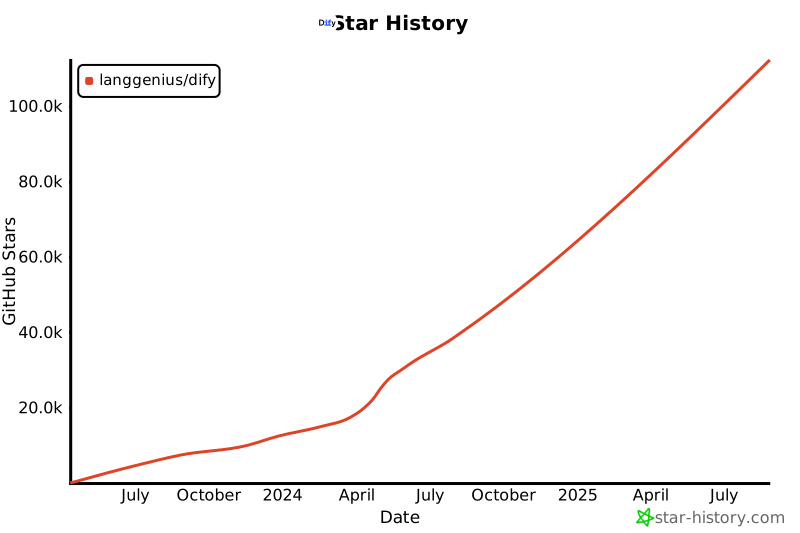](https://star-history.com/#langgenius/dify&Date)
## নিরাপত্তা বিষয়ক
আপনার গোপনীয়তা রক্ষা করতে, অনুগ্রহ করে GitHub-এ নিরাপত্তা সংক্রান্ত সমস্যা পোস্ট করা এড়িয়ে চলুন। পরিবর্তে, আপনার প্রশ্নগুলি <security@dify.ai> ঠিকানায় পাঠান এবং আমরা আপনাকে আরও বিস্তারিত উত্তর প্রদান করব।
## লাইসেন্স
এই রিপোজিটরিটি [ডিফাই ওপেন সোর্স লাইসেন্স](LICENSE) এর অধিনে , যা মূলত অ্যাপাচি ২.০, তবে কিছু অতিরিক্ত বিধিনিষেধ রয়েছে।
<ahref="./README_VI.md"><imgalt="README Tiếng Việt"src="https://img.shields.io/badge/Ti%E1%BA%BFng%20Vi%E1%BB%87t-d9d9d9"></a>
<ahref="./README_DE.md"><imgalt="README in Deutsch"src="https://img.shields.io/badge/German-d9d9d9"></a>
<ahref="./README_BN.md"><imgalt="README in বাংলা"src="https://img.shields.io/badge/বাংলা-d9d9d9"></a>
</p>
Dify ist eine Open-Source-Plattform zur Entwicklung von LLM-Anwendungen. Ihre intuitive Benutzeroberfläche vereint agentenbasierte KI-Workflows, RAG-Pipelines, Agentenfunktionen, Modellverwaltung, Überwachungsfunktionen und mehr, sodass Sie schnell von einem Prototyp in die Produktion übergehen können.
## Schnellstart
> Bevor Sie Dify installieren, stellen Sie sicher, dass Ihr System die folgenden Mindestanforderungen erfüllt:
>
>- CPU >= 2 Core
>- RAM >= 4 GiB
</br>
Der einfachste Weg, den Dify-Server zu starten, ist über [docker compose](docker/docker-compose.yaml). Stellen Sie vor dem Ausführen von Dify mit den folgenden Befehlen sicher, dass [Docker](https://docs.docker.com/get-docker/) und [Docker Compose](https://docs.docker.com/compose/install/) auf Ihrem System installiert sind:
```bash
cd dify
cd docker
cp .env.example .env
docker compose up -d
```
Nachdem Sie den Server gestartet haben, können Sie über Ihren Browser auf das Dify Dashboard unter [http://localhost/install](http://localhost/install) zugreifen und den Initialisierungsprozess starten.
#### Hilfe suchen
Bitte beachten Sie unsere [FAQ](https://docs.dify.ai/getting-started/install-self-hosted/faqs), wenn Sie Probleme bei der Einrichtung von Dify haben. Wenden Sie sich an [die Community und uns](#community--contact), falls weiterhin Schwierigkeiten auftreten.
> Wenn Sie zu Dify beitragen oder zusätzliche Entwicklungen durchführen möchten, lesen Sie bitte unseren [Leitfaden zur Bereitstellung aus dem Quellcode](https://docs.dify.ai/getting-started/install-self-hosted/local-source-code).
## Wesentliche Merkmale
**1. Workflow**:
Erstellen und testen Sie leistungsstarke KI-Workflows auf einer visuellen Oberfläche, wobei Sie alle der folgenden Funktionen und darüber hinaus nutzen können.
Nahtlose Integration mit Hunderten von proprietären und Open-Source-LLMs von Dutzenden Inferenzanbietern und selbstgehosteten Lösungen, die GPT, Mistral, Llama3 und alle mit der OpenAI API kompatiblen Modelle abdecken. Eine vollständige Liste der unterstützten Modellanbieter finden Sie [hier](https://docs.dify.ai/getting-started/readme/model-providers).
Intuitive Benutzeroberfläche zum Erstellen von Prompts, zum Vergleichen der Modellleistung und zum Hinzufügen zusätzlicher Funktionen wie Text-to-Speech in einer chatbasierten Anwendung.
**4. RAG Pipeline**:
Umfassende RAG-Funktionalitäten, die alles von der Dokumenteneinlesung bis zur -abfrage abdecken, mit sofort einsatzbereiter Unterstützung für die Textextraktion aus PDFs, PPTs und anderen gängigen Dokumentformaten.
**5. Fähigkeiten des Agenten**:
Sie können Agenten basierend auf LLM Function Calling oder ReAct definieren und vorgefertigte oder benutzerdefinierte Tools für den Agenten hinzufügen. Dify stellt über 50 integrierte Tools für KI-Agenten bereit, wie zum Beispiel Google Search, DALL·E, Stable Diffusion und WolframAlpha.
**6. LLMOps**:
Überwachen und analysieren Sie Anwendungsprotokolle und die Leistung im Laufe der Zeit. Sie können kontinuierlich Prompts, Datensätze und Modelle basierend auf Produktionsdaten und Annotationen verbessern.
**7. Backend-as-a-Service**:
Alle Dify-Angebote kommen mit entsprechenden APIs, sodass Sie Dify mühelos in Ihre eigene Geschäftslogik integrieren können.
Wir hosten einen [Dify Cloud](https://dify.ai)-Service, den jeder ohne Einrichtung ausprobieren kann. Er bietet alle Funktionen der selbstgehosteten Version und beinhaltet 200 kostenlose GPT-4-Aufrufe im Sandbox-Plan.
- **Selbstgehostete Dify Community Edition</br>**
Starten Sie Dify schnell in Ihrer Umgebung mit diesem [Schnellstart-Leitfaden](#quick-start). Nutzen Sie unsere [Dokumentation](https://docs.dify.ai) für weiterführende Informationen und detaillierte Anweisungen.
- **Dify für Unternehmen / Organisationen</br>**
Wir bieten zusätzliche, unternehmensspezifische Funktionen. [Über diesen Chatbot können Sie uns Ihre Fragen mitteilen](https://udify.app/chat/22L1zSxg6yW1cWQg) oder [senden Sie uns eine E-Mail](mailto:business@dify.ai?subject=[GitHub]Business%20License%20Inquiry), um Ihre unternehmerischen Bedürfnisse zu besprechen. </br>
> Für Startups und kleine Unternehmen, die AWS nutzen, schauen Sie sich [Dify Premium on AWS Marketplace](https://aws.amazon.com/marketplace/pp/prodview-t22mebxzwjhu6) an und stellen Sie es mit nur einem Klick in Ihrer eigenen AWS VPC bereit. Es handelt sich um ein erschwingliches AMI-Angebot mit der Option, Apps mit individuellem Logo und Branding zu erstellen.
## Immer einen Schritt voraus
Star Dify auf GitHub und lassen Sie sich sofort über neue Releases benachrichtigen.
Falls Sie die Konfiguration anpassen müssen, lesen Sie bitte die Kommentare in unserer [.env.example](docker/.env.example)-Datei und aktualisieren Sie die entsprechenden Werte in Ihrer `.env`-Datei. Zusätzlich müssen Sie eventuell Anpassungen an der `docker-compose.yaml`-Datei vornehmen, wie zum Beispiel das Ändern von Image-Versionen, Portzuordnungen oder Volumen-Mounts, je nach Ihrer spezifischen Einsatzumgebung und Ihren Anforderungen. Nachdem Sie Änderungen vorgenommen haben, starten Sie `docker-compose up -d` erneut. Eine vollständige Liste der verfügbaren Umgebungsvariablen finden Sie [hier](https://docs.dify.ai/getting-started/install-self-hosted/environments).
Falls Sie eine hochverfügbare Konfiguration einrichten möchten, gibt es von der Community bereitgestellte [Helm Charts](https://helm.sh/) und YAML-Dateien, die es ermöglichen, Dify auf Kubernetes bereitzustellen.
- [Helm Chart by @LeoQuote](https://github.com/douban/charts/tree/master/charts/dify)
- [Helm Chart by @BorisPolonsky](https://github.com/BorisPolonsky/dify-helm)
- [Helm Chart by @magicsong](https://github.com/magicsong/ai-charts)
- [YAML file by @Winson-030](https://github.com/Winson-030/dify-kubernetes)
- [YAML file by @wyy-holding](https://github.com/wyy-holding/dify-k8s)
#### Terraform für die Bereitstellung verwenden
Stellen Sie Dify mit nur einem Klick mithilfe von [terraform](https://www.terraform.io/) auf einer Cloud-Plattform bereit.
##### Azure Global
- [Azure Terraform by @nikawang](https://github.com/nikawang/dify-azure-terraform)
##### Google Cloud
- [Google Cloud Terraform by @sotazum](https://github.com/DeNA/dify-google-cloud-terraform)
#### Verwendung von AWS CDK für die Bereitstellung
Bereitstellung von Dify auf AWS mit [CDK](https://aws.amazon.com/cdk/)
##### AWS
- [AWS CDK by @KevinZhao](https://github.com/aws-samples/solution-for-deploying-dify-on-aws)
## Contributing
Falls Sie Code beitragen möchten, lesen Sie bitte unseren [Contribution Guide](https://github.com/langgenius/dify/blob/main/CONTRIBUTING.md). Gleichzeitig bitten wir Sie, Dify zu unterstützen, indem Sie es in den sozialen Medien teilen und auf Veranstaltungen und Konferenzen präsentieren.
> Wir suchen Mitwirkende, die dabei helfen, Dify in weitere Sprachen zu übersetzen – außer Mandarin oder Englisch. Wenn Sie Interesse an einer Mitarbeit haben, lesen Sie bitte die [i18n README](https://github.com/langgenius/dify/blob/main/web/i18n/README.md) für weitere Informationen und hinterlassen Sie einen Kommentar im `global-users`-Kanal unseres [Discord Community Servers](https://discord.gg/8Tpq4AcN9c).
## Gemeinschaft & Kontakt
* [Github Discussion](https://github.com/langgenius/dify/discussions). Am besten geeignet für: den Austausch von Feedback und das Stellen von Fragen.
* [GitHub Issues](https://github.com/langgenius/dify/issues). Am besten für: Fehler, auf die Sie bei der Verwendung von Dify.AI stoßen, und Funktionsvorschläge. Siehe unseren [Contribution Guide](https://github.com/langgenius/dify/blob/main/CONTRIBUTING.md).
* [Discord](https://discord.gg/FngNHpbcY7). Am besten geeignet für: den Austausch von Bewerbungen und den Austausch mit der Community.
* [X(Twitter)](https://twitter.com/dify_ai). Am besten geeignet für: den Austausch von Bewerbungen und den Austausch mit der Community.
[](https://star-history.com/#langgenius/dify&Date)
## Offenlegung der Sicherheit
Um Ihre Privatsphäre zu schützen, vermeiden Sie es bitte, Sicherheitsprobleme auf GitHub zu posten. Schicken Sie Ihre Fragen stattdessen an security@dify.ai und wir werden Ihnen eine ausführlichere Antwort geben.
## Lizenz
Dieses Repository steht unter der [Dify Open Source License](LICENSE), die im Wesentlichen Apache 2.0 mit einigen zusätzlichen Einschränkungen ist.
<imgalt="Actividad de Commits el último mes"src="https://img.shields.io/github/commit-activity/m/langgenius/dify?labelColor=%20%2332b583&color=%20%2312b76a"></a>
Dify es una plataforma de desarrollo de aplicaciones de LLM de código abierto. Su interfaz intuitiva combina flujo de trabajo de IA, pipeline RAG, capacidades de agente, gestión de modelos, características de observabilidad y más, lo que le permite pasar rápidamente de un prototipo a producción. Aquí hay una lista de las características principales:
</br></br>
**1. Flujo de trabajo**:
Construye y prueba potentes flujos de trabajo de IA en un lienzo visual, aprovechando todas las siguientes características y más.
Integración perfecta con cientos de LLMs propietarios / de código abierto de docenas de proveedores de inferencia y soluciones auto-alojadas, que cubren GPT, Mistral, Llama3 y cualquier modelo compatible con la API de OpenAI. Se puede encontrar una lista completa de proveedores de modelos admitidos [aquí](https://docs.dify.ai/getting-started/readme/model-providers).
Interfaz intuitiva para crear prompts, comparar el rendimiento del modelo y agregar características adicionales como texto a voz a una aplicación basada en chat.
**4. Pipeline RAG**:
Amplias capacidades de RAG que cubren todo, desde la ingestión de documentos hasta la recuperación, con soporte listo para usar para la extracción de texto de PDF, PPT y otros formatos de documento comunes.
**5. Capacidades de agente**:
Puedes definir agentes basados en LLM Function Calling o ReAct, y agregar herramientas preconstruidas o personalizadas para el agente. Dify proporciona más de 50 herramientas integradas para agentes de IA, como Búsqueda de Google, DALL·E, Difusión Estable y WolframAlpha.
**6. LLMOps**:
Supervisa y analiza registros de aplicaciones y rendimiento a lo largo del tiempo. Podrías mejorar continuamente prompts, conjuntos de datos y modelos basados en datos de producción y anotaciones.
**7. Backend como servicio**:
Todas las ofertas de Dify vienen con APIs correspondientes, por lo que podrías integrar Dify sin esfuerzo en tu propia lógica empresarial.
## Comparación de características
<tablestyle="width: 100%;">
<tr>
<thalign="center">Característica</th>
<thalign="center">Dify.AI</th>
<thalign="center">LangChain</th>
<thalign="center">Flowise</th>
<thalign="center">API de Asistentes de OpenAI</th>
</tr>
<tr>
<tdalign="center">Enfoque de programación</td>
<tdalign="center">API + orientado a la aplicación</td>
<tdalign="center">Código Python</td>
<tdalign="center">Orientado a la aplicación</td>
<tdalign="center">Orientado a la API</td>
</tr>
<tr>
<tdalign="center">LLMs admitidos</td>
<tdalign="center">Gran variedad</td>
<tdalign="center">Gran variedad</td>
<tdalign="center">Gran variedad</td>
<tdalign="center">Solo OpenAI</td>
</tr>
<tr>
<tdalign="center">Motor RAG</td>
<tdalign="center">✅</td>
<tdalign="center">✅</td>
<tdalign="center">✅</td>
<tdalign="center">✅</td>
</tr>
<tr>
<tdalign="center">Agente</td>
<tdalign="center">✅</td>
<tdalign="center">✅</td>
<tdalign="center">❌</td>
<tdalign="center">✅</td>
</tr>
<tr>
<tdalign="center">Flujo de trabajo</td>
<tdalign="center">✅</td>
<tdalign="center">❌</td>
<tdalign="center">✅</td>
<tdalign="center">❌</td>
</tr>
<tr>
<tdalign="center">Observabilidad</td>
<tdalign="center">✅</td>
<tdalign="center">✅</td>
<tdalign="center">❌</td>
<tdalign="center">❌</td>
</tr>
<tr>
<tdalign="center">Característica empresarial (SSO/Control de acceso)</td>
<tdalign="center">✅</td>
<tdalign="center">❌</td>
<tdalign="center">❌</td>
<tdalign="center">❌</td>
</tr>
<tr>
<tdalign="center">Implementación local</td>
<tdalign="center">✅</td>
<tdalign="center">✅</td>
<tdalign="center">✅</td>
<tdalign="center">❌</td>
</tr>
</table>
## Usando Dify
- **Nube </br>**
Hospedamos un servicio [Dify Cloud](https://dify.ai) para que cualquiera lo pruebe sin configuración. Proporciona todas las capacidades de la versión autoimplementada e incluye 200 llamadas gratuitas a GPT-4 en el plan sandbox.
- **Auto-alojamiento de Dify Community Edition</br>**
Pon rápidamente Dify en funcionamiento en tu entorno con esta [guía de inicio rápido](#quick-start).
Usa nuestra [documentación](https://docs.dify.ai) para más referencias e instrucciones más detalladas.
- **Dify para Empresas / Organizaciones</br>**
Proporcionamos características adicionales centradas en la empresa. [Envíanos un correo electrónico](mailto:business@dify.ai?subject=[GitHub]Business%20License%20Inquiry) para discutir las necesidades empresariales. </br>
> Para startups y pequeñas empresas que utilizan AWS, echa un vistazo a [Dify Premium en AWS Marketplace](https://aws.amazon.com/marketplace/pp/prodview-t22mebxzwjhu6) e impleméntalo en tu propio VPC de AWS con un clic. Es una AMI asequible que ofrece la opción de crear aplicaciones con logotipo y marca personalizados.
## Manteniéndote al tanto
Dale estrella a Dify en GitHub y serás notificado instantáneamente de las nuevas versiones.
> Antes de instalar Dify, asegúrate de que tu máquina cumpla con los siguientes requisitos mínimos del sistema:
>
>- CPU >= 2 núcleos
>- RAM >= 4GB
</br>
La forma más fácil de iniciar el servidor de Dify es ejecutar nuestro archivo [docker-compose.yml](docker/docker-compose.yaml). Antes de ejecutar el comando de instalación, asegúrate de que [Docker](https://docs.docker.com/get-docker/) y [Docker Compose](https://docs.docker.com/compose/install/) estén instalados en tu máquina:
```bash
cd docker
cp .env.example .env
docker compose up -d
```
Después de ejecutarlo, puedes acceder al panel de control de Dify en tu navegador en [http://localhost/install](http://localhost/install) y comenzar el proceso de inicialización.
> Si deseas contribuir a Dify o realizar desarrollo adicional, consulta nuestra [guía para implementar desde el código fuente](https://docs.dify.ai/getting-started/install-self-hosted/local-source-code)
## Próximos pasos
Si necesita personalizar la configuración, consulte los comentarios en nuestro archivo [.env.example](docker/.env.example) y actualice los valores correspondientes en su archivo `.env`. Además, es posible que deba realizar ajustes en el propio archivo `docker-compose.yaml`, como cambiar las versiones de las imágenes, las asignaciones de puertos o los montajes de volúmenes, según su entorno de implementación y requisitos específicos. Después de realizar cualquier cambio, vuelva a ejecutar `docker-compose up -d`. Puede encontrar la lista completa de variables de entorno disponibles [aquí](https://docs.dify.ai/getting-started/install-self-hosted/environments).
. Después de realizar los cambios, ejecuta `docker-compose up -d` nuevamente. Puedes ver la lista completa de variables de entorno [aquí](https://docs.dify.ai/getting-started/install-self-hosted/environments).
Si desea configurar una configuración de alta disponibilidad, la comunidad proporciona [Gráficos Helm](https://helm.sh/) y archivos YAML, a través de los cuales puede desplegar Dify en Kubernetes.
- [Gráfico Helm por @LeoQuote](https://github.com/douban/charts/tree/master/charts/dify)
- [Gráfico Helm por @BorisPolonsky](https://github.com/BorisPolonsky/dify-helm)
- [Gráfico Helm por @magicsong](https://github.com/magicsong/ai-charts)
- [Ficheros YAML por @Winson-030](https://github.com/Winson-030/dify-kubernetes)
- [Ficheros YAML por @wyy-holding](https://github.com/wyy-holding/dify-k8s)
#### Uso de Terraform para el despliegue
Despliega Dify en una plataforma en la nube con un solo clic utilizando [terraform](https://www.terraform.io/)
##### Azure Global
- [Azure Terraform por @nikawang](https://github.com/nikawang/dify-azure-terraform)
##### Google Cloud
- [Google Cloud Terraform por @sotazum](https://github.com/DeNA/dify-google-cloud-terraform)
#### Usando AWS CDK para el Despliegue
Despliegue Dify en AWS usando [CDK](https://aws.amazon.com/cdk/)
##### AWS
- [AWS CDK por @KevinZhao](https://github.com/aws-samples/solution-for-deploying-dify-on-aws)
## Contribuir
Para aquellos que deseen contribuir con código, consulten nuestra [Guía de contribución](https://github.com/langgenius/dify/blob/main/CONTRIBUTING.md).
Al mismo tiempo, considera apoyar a Dify compartiéndolo en redes sociales y en eventos y conferencias.
> Estamos buscando colaboradores para ayudar con la traducción de Dify a idiomas que no sean el mandarín o el inglés. Si estás interesado en ayudar, consulta el [README de i18n](https://github.com/langgenius/dify/blob/main/web/i18n/README.md) para obtener más información y déjanos un comentario en el canal `global-users` de nuestro [Servidor de Comunidad en Discord](https://discord.gg/8Tpq4AcN9c).
* [Discusión en GitHub](https://github.com/langgenius/dify/discussions). Lo mejor para: compartir comentarios y hacer preguntas.
* [Reporte de problemas en GitHub](https://github.com/langgenius/dify/issues). Lo mejor para: errores que encuentres usando Dify.AI y propuestas de características. Consulta nuestra [Guía de contribución](https://github.com/langgenius/dify/blob/main/CONTRIBUTING.md).
* [Discord](https://discord.gg/FngNHpbcY7). Lo mejor para: compartir tus aplicaciones y pasar el rato con la comunidad.
* [X(Twitter)](https://twitter.com/dify_ai). Lo mejor para: compartir tus aplicaciones y pasar el rato con la comunidad.
## Historial de Estrellas
[](https://star-history.com/#langgenius/dify&Date)
## Divulgación de Seguridad
Para proteger tu privacidad, evita publicar problemas de seguridad en GitHub. En su lugar, envía tus preguntas a security@dify.ai y te proporcionaremos una respuesta más detallada.
## Licencia
Este repositorio está disponible bajo la [Licencia de Código Abierto de Dify](LICENSE), que es esencialmente Apache 2.0 con algunas restricciones adicionales.
## Divulgación de Seguridad
Para proteger tu privacidad, evita publicar problemas de seguridad en GitHub. En su lugar, envía tus preguntas a security@dify.ai y te proporcionaremos una respuesta más detallada.
## Licencia
Este repositorio está disponible bajo la [Licencia de Código Abierto de Dify](LICENSE), que es esencialmente Apache 2.0 con algunas restricciones adicionales.
Dify est une plateforme de développement d'applications LLM open source. Son interface intuitive combine un flux de travail d'IA, un pipeline RAG, des capacités d'agent, une gestion de modèles, des fonctionnalités d'observabilité, et plus encore, vous permettant de passer rapidement du prototype à la production. Voici une liste des fonctionnalités principales:
</br></br>
**1. Flux de travail** :
Construisez et testez des flux de travail d'IA puissants sur un canevas visuel, en utilisant toutes les fonctionnalités suivantes et plus encore.
Intégration transparente avec des centaines de LLM propriétaires / open source provenant de dizaines de fournisseurs d'inférence et de solutions auto-hébergées, couvrant GPT, Mistral, Llama3, et tous les modèles compatibles avec l'API OpenAI. Une liste complète des fournisseurs de modèles pris en charge se trouve [ici](https://docs.dify.ai/getting-started/readme/model-providers).
Interface intuitive pour créer des prompts, comparer les performances des modèles et ajouter des fonctionnalités supplémentaires telles que la synthèse vocale à une application basée sur des chats.
**4. Pipeline RAG** :
Des capacités RAG étendues qui couvrent tout, de l'ingestion de documents à la récupération, avec un support prêt à l'emploi pour l'extraction de texte à partir de PDF, PPT et autres formats de document courants.
**5. Capacités d'agent** :
Vous pouvez définir des agents basés sur l'appel de fonction LLM ou ReAct, et ajouter des outils pré-construits ou personnalisés pour l'agent. Dify fournit plus de 50 outils intégrés pour les agents d'IA, tels que la recherche Google, DALL·E, Stable Diffusion et WolframAlpha.
**6. LLMOps** :
Surveillez et analysez les journaux d'application et les performances au fil du temps. Vous pouvez continuellement améliorer les prompts, les ensembles de données et les modèles en fonction des données de production et des annotations.
**7. Backend-as-a-Service** :
Toutes les offres de Dify sont accompagnées d'API correspondantes, vous permettant d'intégrer facilement Dify dans votre propre logique métier.
Nous hébergeons un service [Dify Cloud](https://dify.ai) pour que tout le monde puisse l'essayer sans aucune configuration. Il fournit toutes les capacités de la version auto-hébergée et comprend 200 appels GPT-4 gratuits dans le plan bac à sable.
- **Auto-hébergement Dify Community Edition</br>**
Lancez rapidement Dify dans votre environnement avec ce [guide de démarrage](#quick-start).
Utilisez notre [documentation](https://docs.dify.ai) pour plus de références et des instructions plus détaillées.
- **Dify pour les entreprises / organisations</br>**
Nous proposons des fonctionnalités supplémentaires adaptées aux entreprises. [Envoyez-nous un e-mail](mailto:business@dify.ai?subject=[GitHub]Business%20License%20Inquiry) pour discuter des besoins de l'entreprise. </br>
> Pour les startups et les petites entreprises utilisant AWS, consultez [Dify Premium sur AWS Marketplace](https://aws.amazon.com/marketplace/pp/prodview-t22mebxzwjhu6) et déployez-le dans votre propre VPC AWS en un clic. C'est une offre AMI abordable avec la possibilité de créer des applications avec un logo et une marque personnalisés.
## Rester en avance
Mettez une étoile à Dify sur GitHub et soyez instantanément informé des nouvelles versions.
> Avant d'installer Dify, assurez-vous que votre machine répond aux exigences système minimales suivantes:
>
>- CPU >= 2 cœurs
>- RAM >= 4 Go
</br>
La manière la plus simple de démarrer le serveur Dify est d'exécuter notre fichier [docker-compose.yml](docker/docker-compose.yaml). Avant d'exécuter la commande d'installation, assurez-vous que [Docker](https://docs.docker.com/get-docker/) et [Docker Compose](https://docs.docker.com/compose/install/) sont installés sur votre machine:
```bash
cd docker
cp .env.example .env
docker compose up -d
```
Après l'exécution, vous pouvez accéder au tableau de bord Dify dans votre navigateur à [http://localhost/install](http://localhost/install) et commencer le processus d'initialisation.
> Si vous souhaitez contribuer à Dify ou effectuer un développement supplémentaire, consultez notre [guide de déploiement à partir du code source](https://docs.dify.ai/getting-started/install-self-hosted/local-source-code)
## Prochaines étapes
Si vous devez personnaliser la configuration, veuillez vous référer aux commentaires dans notre fichier [.env.example](docker/.env.example) et mettre à jour les valeurs correspondantes dans votre fichier `.env`. De plus, vous devrez peut-être apporter des modifications au fichier `docker-compose.yaml` lui-même, comme changer les versions d'image, les mappages de ports ou les montages de volumes, en fonction de votre environnement de déploiement et de vos exigences spécifiques. Après avoir effectué des modifications, veuillez réexécuter `docker-compose up -d`. Vous pouvez trouver la liste complète des variables d'environnement disponibles [ici](https://docs.dify.ai/getting-started/install-self-hosted/environments).
Si vous souhaitez configurer une configuration haute disponibilité, la communauté fournit des [Helm Charts](https://helm.sh/) et des fichiers YAML, à travers lesquels vous pouvez déployer Dify sur Kubernetes.
- [Helm Chart par @LeoQuote](https://github.com/douban/charts/tree/master/charts/dify)
- [Helm Chart par @BorisPolonsky](https://github.com/BorisPolonsky/dify-helm)
- [Helm Chart par @magicsong](https://github.com/magicsong/ai-charts)
- [Fichier YAML par @Winson-030](https://github.com/Winson-030/dify-kubernetes)
- [Fichier YAML par @wyy-holding](https://github.com/wyy-holding/dify-k8s)
#### Utilisation de Terraform pour le déploiement
Déployez Dify sur une plateforme cloud en un clic en utilisant [terraform](https://www.terraform.io/)
##### Azure Global
- [Azure Terraform par @nikawang](https://github.com/nikawang/dify-azure-terraform)
##### Google Cloud
- [Google Cloud Terraform par @sotazum](https://github.com/DeNA/dify-google-cloud-terraform)
#### Utilisation d'AWS CDK pour le déploiement
Déployez Dify sur AWS en utilisant [CDK](https://aws.amazon.com/cdk/)
##### AWS
- [AWS CDK par @KevinZhao](https://github.com/aws-samples/solution-for-deploying-dify-on-aws)
## Contribuer
Pour ceux qui souhaitent contribuer du code, consultez notre [Guide de contribution](https://github.com/langgenius/dify/blob/main/CONTRIBUTING.md).
Dans le même temps, veuillez envisager de soutenir Dify en le partageant sur les réseaux sociaux et lors d'événements et de conférences.
> Nous recherchons des contributeurs pour aider à traduire Dify dans des langues autres que le mandarin ou l'anglais. Si vous êtes intéressé à aider, veuillez consulter le [README i18n](https://github.com/langgenius/dify/blob/main/web/i18n/README.md) pour plus d'informations, et laissez-nous un commentaire dans le canal `global-users` de notre [Serveur communautaire Discord](https://discord.gg/8Tpq4AcN9c).
* [Discussion GitHub](https://github.com/langgenius/dify/discussions). Meilleur pour: partager des commentaires et poser des questions.
* [Problèmes GitHub](https://github.com/langgenius/dify/issues). Meilleur pour: les bogues que vous rencontrez en utilisant Dify.AI et les propositions de fonctionnalités. Consultez notre [Guide de contribution](https://github.com/langgenius/dify/blob/main/CONTRIBUTING.md).
* [Discord](https://discord.gg/FngNHpbcY7). Meilleur pour: partager vos applications et passer du temps avec la communauté.
* [X(Twitter)](https://twitter.com/dify_ai). Meilleur pour: partager vos applications et passer du temps avec la communauté.
## Historique des étoiles
[](https://star-history.com/#langgenius/dify&Date)
## Divulgation de sécurité
Pour protéger votre vie privée, veuillez éviter de publier des problèmes de sécurité sur GitHub. Au lieu de cela, envoyez vos questions à security@dify.ai et nous vous fournirons une réponse plus détaillée.
## Licence
Ce référentiel est disponible sous la [Licence open source Dify](LICENSE), qui est essentiellement l'Apache 2.0 avec quelques restrictions supplémentaires.
## Divulgation de sécurité
Pour protéger votre vie privée, veuillez éviter de publier des problèmes de sécurité sur GitHub. Au lieu de cela, envoyez vos questions à security@dify.ai et nous vous fournirons une réponse plus détaillée.
## Licence
Ce référentiel est disponible sous la [Licence open source Dify](LICENSE), qui est essentiellement l'Apache 2.0 avec quelques restrictions supplémentaires.
LLM Function CallingやReActに基づくエージェントの定義が可能で、AIエージェント用のプリビルトまたはカスタムツールを追加できます。Difyには、Google検索、DALL·E、Stable Diffusion、WolframAlphaなどのAIエージェント用の50以上の組み込みツールが提供します。
Dify is an open-source LLM app development platform. Its intuitive interface combines AI workflow, RAG pipeline, agent capabilities, model management, observability features and more, letting you quickly go from prototype to production. Here's a list of the core features:
</br></br>
**1. Workflow**:
Build and test powerful AI workflows on a visual canvas, leveraging all the following features and beyond.
Seamless integration with hundreds of proprietary / open-source LLMs from dozens of inference providers and self-hosted solutions, covering GPT, Mistral, Llama3, and any OpenAI API-compatible models. A full list of supported model providers can be found [here](https://docs.dify.ai/getting-started/readme/model-providers).
Intuitive interface for crafting prompts, comparing model performance, and adding additional features such as text-to-speech to a chat-based app.
**4. RAG Pipeline**:
Extensive RAG capabilities that cover everything from document ingestion to retrieval, with out-of-box support for text extraction from PDFs, PPTs, and other common document formats.
**5. Agent capabilities**:
You can define agents based on LLM Function Calling or ReAct, and add pre-built or custom tools for the agent. Dify provides 50+ built-in tools for AI agents, such as Google Search, DALL·E, Stable Diffusion and WolframAlpha.
**6. LLMOps**:
Monitor and analyze application logs and performance over time. You could continuously improve prompts, datasets, and models based on production data and annotations.
**7. Backend-as-a-Service**:
All of Dify's offerings come with corresponding APIs, so you could effortlessly integrate Dify into your own business logic.
We host a [Dify Cloud](https://dify.ai) service for anyone to try with zero setup. It provides all the capabilities of the self-deployed version, and includes 200 free GPT-4 calls in the sandbox plan.
- **Self-hosting Dify Community Edition</br>**
Quickly get Dify running in your environment with this [starter guide](#quick-start).
Use our [documentation](https://docs.dify.ai) for further references and more in-depth instructions.
- **Dify for Enterprise / Organizations</br>**
We provide additional enterprise-centric features. [Send us an email](mailto:business@dify.ai?subject=[GitHub]Business%20License%20Inquiry) to discuss enterprise needs. </br>
> For startups and small businesses using AWS, check out [Dify Premium on AWS Marketplace](https://aws.amazon.com/marketplace/pp/prodview-t22mebxzwjhu6) and deploy it to your own AWS VPC with one-click. It's an affordable AMI offering with the option to create apps with custom logo and branding.
## Staying ahead
Star Dify on GitHub and be instantly notified of new releases.
> Before installing Dify, make sure your machine meets the following minimum system requirements:
>
>- CPU >= 2 Core
>- RAM >= 4GB
</br>
The easiest way to start the Dify server is to run our [docker-compose.yml](docker/docker-compose.yaml) file. Before running the installation command, make sure that [Docker](https://docs.docker.com/get-docker/) and [Docker Compose](https://docs.docker.com/compose/install/) are installed on your machine:
```bash
cd docker
cp .env.example .env
docker compose up -d
```
After running, you can access the Dify dashboard in your browser at [http://localhost/install](http://localhost/install) and start the initialization process.
> If you'd like to contribute to Dify or do additional development, refer to our [guide to deploying from source code](https://docs.dify.ai/getting-started/install-self-hosted/local-source-code)
## Next steps
If you need to customize the configuration, please refer to the comments in our [.env.example](docker/.env.example) file and update the corresponding values in your `.env` file. Additionally, you might need to make adjustments to the `docker-compose.yaml` file itself, such as changing image versions, port mappings, or volume mounts, based on your specific deployment environment and requirements. After making any changes, please re-run `docker-compose up -d`. You can find the full list of available environment variables [here](https://docs.dify.ai/getting-started/install-self-hosted/environments).
If you'd like to configure a highly-available setup, there are community-contributed [Helm Charts](https://helm.sh/) and YAML files which allow Dify to be deployed on Kubernetes.
- [Helm Chart by @LeoQuote](https://github.com/douban/charts/tree/master/charts/dify)
- [Helm Chart by @BorisPolonsky](https://github.com/BorisPolonsky/dify-helm)
- [Helm Chart by @magicsong](https://github.com/magicsong/ai-charts)
- [YAML file by @Winson-030](https://github.com/Winson-030/dify-kubernetes)
- [YAML file by @wyy-holding](https://github.com/wyy-holding/dify-k8s)
For those who'd like to contribute code, see our [Contribution Guide](https://github.com/langgenius/dify/blob/main/CONTRIBUTING.md).
At the same time, please consider supporting Dify by sharing it on social media and at events and conferences.
> We are looking for contributors to help with translating Dify to languages other than Mandarin or English. If you are interested in helping, please see the [i18n README](https://github.com/langgenius/dify/blob/main/web/i18n/README.md) for more information, and leave us a comment in the `global-users` channel of our [Discord Community Server](https://discord.gg/8Tpq4AcN9c).
). Best for: sharing feedback and asking questions.
* [GitHub Issues](https://github.com/langgenius/dify/issues). Best for: bugs you encounter using Dify.AI, and feature proposals. See our [Contribution Guide](https://github.com/langgenius/dify/blob/main/CONTRIBUTING.md).
* [Discord](https://discord.gg/FngNHpbcY7). Best for: sharing your applications and hanging out with the community.
* [X(Twitter)](https://twitter.com/dify_ai). Best for: sharing your applications and hanging out with the community.
## Star History
[](https://star-history.com/#langgenius/dify&Date)
## Security Disclosure
To protect your privacy, please avoid posting security issues on GitHub. Instead, send your questions to security@dify.ai and we will provide you with a more detailed answer.
## License
This repository is available under the [Dify Open Source License](LICENSE), which is essentially Apache 2.0 with a few additional restrictions.
<ahref="./README_VI.md"><imgalt="README Tiếng Việt"src="https://img.shields.io/badge/Ti%E1%BA%BFng%20Vi%E1%BB%87t-d9d9d9"></a>
<ahref="./README_BN.md"><imgalt="README in বাংলা"src="https://img.shields.io/badge/বাংলা-d9d9d9"></a>
</p>
Dify는 오픈 소스 LLM 앱 개발 플랫폼입니다. 직관적인 인터페이스를 통해 AI 워크플로우, RAG 파이프라인, 에이전트 기능, 모델 관리, 관찰 기능 등을 결합하여 프로토타입에서 프로덕션까지 빠르게 전환할 수 있습니다. 주요 기능 목록은 다음과 같습니다:</br></br>
**1. 워크플로우**:
다음 기능들을 비롯한 다양한 기능을 활용하여 시각적 캔버스에서 강력한 AI 워크플로우를 구축하고 테스트하세요.
수십 개의 추론 제공업체와 자체 호스팅 솔루션에서 제공하는 수백 개의 독점 및 오픈 소스 LLM과 원활하게 통합되며, GPT, Mistral, Llama3 및 모든 OpenAI API 호환 모델을 포함합니다. 지원되는 모델 제공업체의 전체 목록은 [여기](https://docs.dify.ai/getting-started/readme/model-providers)에서 확인할 수 있습니다.
프롬프트를 작성하고, 모델 성능을 비교하며, 텍스트-음성 변환과 같은 추가 기능을 채팅 기반 앱에 추가할 수 있는 직관적인 인터페이스를 제공합니다.
**4. RAG 파이프라인**:
문서 수집부터 검색까지 모든 것을 다루며, PDF, PPT 및 기타 일반적인 문서 형식에서 텍스트 추출을 위한 기본 지원이 포함되어 있는 광범위한 RAG 기능을 제공합니다.
**5. 에이전트 기능**:
LLM 함수 호출 또는 ReAct를 기반으로 에이전트를 정의하고 에이전트에 대해 사전 구축된 도구나 사용자 정의 도구를 추가할 수 있습니다. Dify는 Google Search, DALL·E, Stable Diffusion, WolframAlpha 등 AI 에이전트를 위한 50개 이상의 내장 도구를 제공합니다.
**6. LLMOps**:
시간 경과에 따른 애플리케이션 로그와 성능을 모니터링하고 분석합니다. 생산 데이터와 주석을 기반으로 프롬프트, 데이터세트, 모델을 지속적으로 개선할 수 있습니다.
**7. Backend-as-a-Service**:
Dify의 모든 제품에는 해당 API가 함께 제공되므로 Dify를 자신의 비즈니스 로직에 쉽게 통합할 수 있습니다.
## 기능 비교
<tablestyle="width: 100%;">
<tr>
<thalign="center">기능</th>
<thalign="center">Dify.AI</th>
<thalign="center">LangChain</th>
<thalign="center">Flowise</th>
<thalign="center">OpenAI Assistants API</th>
</tr>
<tr>
<tdalign="center">프로그래밍 접근 방식</td>
<tdalign="center">API + 앱 중심</td>
<tdalign="center">Python 코드</td>
<tdalign="center">앱 중심</td>
<tdalign="center">API 중심</td>
</tr>
<tr>
<tdalign="center">지원되는 LLMs</td>
<tdalign="center">다양한 종류</td>
<tdalign="center">다양한 종류</td>
<tdalign="center">다양한 종류</td>
<tdalign="center">OpenAI 전용</td>
</tr>
<tr>
<tdalign="center">RAG 엔진</td>
<tdalign="center">✅</td>
<tdalign="center">✅</td>
<tdalign="center">✅</td>
<tdalign="center">✅</td>
</tr>
<tr>
<tdalign="center">에이전트</td>
<tdalign="center">✅</td>
<tdalign="center">✅</td>
<tdalign="center">❌</td>
<tdalign="center">✅</td>
</tr>
<tr>
<tdalign="center">워크플로우</td>
<tdalign="center">✅</td>
<tdalign="center">❌</td>
<tdalign="center">✅</td>
<tdalign="center">❌</td>
</tr>
<tr>
<tdalign="center">가시성</td>
<tdalign="center">✅</td>
<tdalign="center">✅</td>
<tdalign="center">❌</td>
<tdalign="center">❌</td>
</tr>
<tr>
<tdalign="center">기업용 기능 (SSO/접근 제어)</td>
<tdalign="center">✅</td>
<tdalign="center">❌</td>
<tdalign="center">❌</td>
<tdalign="center">❌</td>
</tr>
<tr>
<tdalign="center">로컬 배포</td>
<tdalign="center">✅</td>
<tdalign="center">✅</td>
<tdalign="center">✅</td>
<tdalign="center">❌</td>
</tr>
</table>
## Dify 사용하기
- **클라우드 </br>**
우리는 누구나 설정이 필요 없이 사용해 볼 수 있도록 [Dify 클라우드](https://dify.ai) 서비스를 호스팅합니다. 이는 자체 배포 버전의 모든 기능을 제공하며, 샌드박스 플랜에서 무료로 200회의 GPT-4 호출을 포함합니다.
- **셀프-호스팅 Dify 커뮤니티 에디션</br>**
환경에서 Dify를 빠르게 실행하려면 이 [스타터 가이드를](#quick-start) 참조하세요.
추가 참조 및 더 심층적인 지침은 [문서](https://docs.dify.ai)를 사용하세요.
- **기업 / 조직을 위한 Dify</br>**
우리는 추가적인 기업 중심 기능을 제공합니다. 잡거나 [이메일 보내기](mailto:business@dify.ai?subject=[GitHub]Business%20License%20Inquiry)를 통해 기업 요구 사항을 논의하십시오. </br>
> AWS를 사용하는 스타트업 및 중소기업의 경우 [AWS Marketplace에서 Dify Premium](https://aws.amazon.com/marketplace/pp/prodview-t22mebxzwjhu6)을 확인하고 한 번의 클릭으로 자체 AWS VPC에 배포하십시오. 맞춤형 로고와 브랜딩이 포함된 앱을 생성할 수 있는 옵션이 포함된 저렴한 AMI 제품입니다.
>Dify를 설치하기 전에 컴퓨터가 다음과 같은 최소 시스템 요구 사항을 충족하는지 확인하세요 :
>- CPU >= 2 Core
>- RAM >= 4GB
</br>
Dify 서버를 시작하는 가장 쉬운 방법은 [docker-compose.yml](docker/docker-compose.yaml) 파일을 실행하는 것입니다. 설치 명령을 실행하기 전에 [Docker](https://docs.docker.com/get-docker/) 및 [Docker Compose](https://docs.docker.com/compose/install/)가 머신에 설치되어 있는지 확인하세요.
```bash
cd docker
cp .env.example .env
docker compose up -d
```
실행 후 브라우저의 [http://localhost/install](http://localhost/install) 에서 Dify 대시보드에 액세스하고 초기화 프로세스를 시작할 수 있습니다.
> Dify에 기여하거나 추가 개발을 하고 싶다면 소스 코드에서 [배포에 대한 가이드](https://docs.dify.ai/getting-started/install-self-hosted/local-source-code)를 참조하세요.
## 다음 단계
구성을 사용자 정의해야 하는 경우 [.env.example](docker/.env.example) 파일의 주석을 참조하고 `.env` 파일에서 해당 값을 업데이트하십시오. 또한 특정 배포 환경 및 요구 사항에 따라 `docker-compose.yaml` 파일 자체를 조정해야 할 수도 있습니다. 예를 들어 이미지 버전, 포트 매핑 또는 볼륨 마운트를 변경합니다. 변경 한 후 `docker-compose up -d`를 다시 실행하십시오. 사용 가능한 환경 변수의 전체 목록은 [여기](https://docs.dify.ai/getting-started/install-self-hosted/environments)에서 찾을 수 있습니다.
Dify를 Kubernetes에 배포하고 프리미엄 스케일링 설정을 구성했다는 커뮤니티가 제공하는 [Helm Charts](https://helm.sh/)와 YAML 파일이 존재합니다.
- [Helm Chart by @LeoQuote](https://github.com/douban/charts/tree/master/charts/dify)
- [Helm Chart by @BorisPolonsky](https://github.com/BorisPolonsky/dify-helm)
- [Helm Chart by @magicsong](https://github.com/magicsong/ai-charts)
- [YAML file by @Winson-030](https://github.com/Winson-030/dify-kubernetes)
- [YAML file by @wyy-holding](https://github.com/wyy-holding/dify-k8s)
#### Terraform을 사용한 배포
[terraform](https://www.terraform.io/)을 사용하여 단 한 번의 클릭으로 Dify를 클라우드 플랫폼에 배포하십시오
코드에 기여하고 싶은 분들은 [기여 가이드](https://github.com/langgenius/dify/blob/main/CONTRIBUTING.md)를 참조하세요.
동시에 Dify를 소셜 미디어와 행사 및 컨퍼런스에 공유하여 지원하는 것을 고려해 주시기 바랍니다.
> 우리는 Dify를 중국어나 영어 이외의 언어로 번역하는 데 도움을 줄 수 있는 기여자를 찾고 있습니다. 도움을 주고 싶으시다면 [i18n README](https://github.com/langgenius/dify/blob/main/web/i18n/README.md)에서 더 많은 정보를 확인하시고 [Discord 커뮤니티 서버](https://discord.gg/8Tpq4AcN9c)의 `global-users` 채널에 댓글을 남겨주세요.
* [Github 토론](https://github.com/langgenius/dify/discussions). 피드백 공유 및 질문하기에 적합합니다.
* [GitHub 이슈](https://github.com/langgenius/dify/issues). Dify.AI 사용 중 발견한 버그와 기능 제안에 적합합니다. [기여 가이드](https://github.com/langgenius/dify/blob/main/CONTRIBUTING.md)를 참조하세요.
* [디스코드](https://discord.gg/FngNHpbcY7). 애플리케이션 공유 및 커뮤니티와 소통하기에 적합합니다.
* [트위터](https://twitter.com/dify_ai). 애플리케이션 공유 및 커뮤니티와 소통하기에 적합합니다.
## Star 히스토리
[](https://star-history.com/#langgenius/dify&Date)
## 보안 공개
개인정보 보호를 위해 보안 문제를 GitHub에 게시하지 마십시오. 대신 security@dify.ai로 질문을 보내주시면 더 자세한 답변을 드리겠습니다.
## 라이선스
이 저장소는 기본적으로 몇 가지 추가 제한 사항이 있는 Apache 2.0인 [Dify 오픈 소스 라이선스](LICENSE)에 따라 사용할 수 있습니다.
📌 <ahref="https://dify.ai/blog/introducing-dify-workflow-file-upload-a-demo-on-ai-podcast">Introduzindo o Dify Workflow com Upload de Arquivo: Recrie o Podcast Google NotebookLM</a>
<ahref="./README_KR.md"><imgalt="README em Coreano"src="https://img.shields.io/badge/한국어-d9d9d9"></a>
<ahref="./README_AR.md"><imgalt="README em Árabe"src="https://img.shields.io/badge/العربية-d9d9d9"></a>
<ahref="./README_TR.md"><imgalt="README em Turco"src="https://img.shields.io/badge/Türkçe-d9d9d9"></a>
<ahref="./README_VI.md"><imgalt="README em Vietnamita"src="https://img.shields.io/badge/Ti%E1%BA%BFng%20Vi%E1%BB%87t-d9d9d9"></a>
<ahref="./README_PT.md"><imgalt="README em Português - BR"src="https://img.shields.io/badge/Portugu%C3%AAs-BR?style=flat&label=BR&color=d9d9d9"></a>
<ahref="./README_BN.md"><imgalt="README in বাংলা"src="https://img.shields.io/badge/বাংলা-d9d9d9"></a>
</p>
Dify é uma plataforma de desenvolvimento de aplicativos LLM de código aberto. Sua interface intuitiva combina workflow de IA, pipeline RAG, capacidades de agente, gerenciamento de modelos, recursos de observabilidade e muito mais, permitindo que você vá rapidamente do protótipo à produção. Aqui está uma lista das principais funcionalidades:
</br></br>
**1. Workflow**:
Construa e teste workflows poderosos de IA em uma interface visual, aproveitando todos os recursos a seguir e muito mais.
Integração perfeita com centenas de LLMs proprietários e de código aberto de diversas provedoras e soluções auto-hospedadas, abrangendo GPT, Mistral, Llama3 e qualquer modelo compatível com a API da OpenAI. A lista completa de provedores suportados pode ser encontrada [aqui](https://docs.dify.ai/getting-started/readme/model-providers).
Interface intuitiva para criação de prompts, comparação de desempenho de modelos e adição de recursos como conversão de texto para fala em um aplicativo baseado em chat.
**4. Pipeline RAG**:
Extensas capacidades de RAG que cobrem desde a ingestão de documentos até a recuperação, com suporte nativo para extração de texto de PDFs, PPTs e outros formatos de documentos comuns.
**5. Capacidades de agente**:
Você pode definir agentes com base em LLM Function Calling ou ReAct e adicionar ferramentas pré-construídas ou personalizadas para o agente. O Dify oferece mais de 50 ferramentas integradas para agentes de IA, como Google Search, DALL·E, Stable Diffusion e WolframAlpha.
**6. LLMOps**:
Monitore e analise os registros e o desempenho do aplicativo ao longo do tempo. É possível melhorar continuamente prompts, conjuntos de dados e modelos com base nos dados de produção e anotações.
**7. Backend como Serviço**:
Todas os recursos do Dify vêm com APIs correspondentes, permitindo que você integre o Dify sem esforço na lógica de negócios da sua empresa.
## Comparação de recursos
<tablestyle="width: 100%;">
<tr>
<thalign="center">Recurso</th>
<thalign="center">Dify.AI</th>
<thalign="center">LangChain</th>
<thalign="center">Flowise</th>
<thalign="center">OpenAI Assistants API</th>
</tr>
<tr>
<tdalign="center">Abordagem de Programação</td>
<tdalign="center">Orientada a API + Aplicativo</td>
<tdalign="center">Código Python</td>
<tdalign="center">Orientada a Aplicativo</td>
<tdalign="center">Orientada a API</td>
</tr>
<tr>
<tdalign="center">LLMs Suportados</td>
<tdalign="center">Variedade Rica</td>
<tdalign="center">Variedade Rica</td>
<tdalign="center">Variedade Rica</td>
<tdalign="center">Apenas OpenAI</td>
</tr>
<tr>
<tdalign="center">RAG Engine</td>
<tdalign="center">✅</td>
<tdalign="center">✅</td>
<tdalign="center">✅</td>
<tdalign="center">✅</td>
</tr>
<tr>
<tdalign="center">Agente</td>
<tdalign="center">✅</td>
<tdalign="center">✅</td>
<tdalign="center">❌</td>
<tdalign="center">✅</td>
</tr>
<tr>
<tdalign="center">Workflow</td>
<tdalign="center">✅</td>
<tdalign="center">❌</td>
<tdalign="center">✅</td>
<tdalign="center">❌</td>
</tr>
<tr>
<tdalign="center">Observabilidade</td>
<tdalign="center">✅</td>
<tdalign="center">✅</td>
<tdalign="center">❌</td>
<tdalign="center">❌</td>
</tr>
<tr>
<tdalign="center">Recursos Empresariais (SSO/Controle de Acesso)</td>
<tdalign="center">✅</td>
<tdalign="center">❌</td>
<tdalign="center">❌</td>
<tdalign="center">❌</td>
</tr>
<tr>
<tdalign="center">Implantação Local</td>
<tdalign="center">✅</td>
<tdalign="center">✅</td>
<tdalign="center">✅</td>
<tdalign="center">❌</td>
</tr>
</table>
## Usando o Dify
- **Nuvem </br>**
Oferecemos o serviço [Dify Cloud](https://dify.ai) para qualquer pessoa experimentar sem nenhuma configuração. Ele fornece todas as funcionalidades da versão auto-hospedada, incluindo 200 chamadas GPT-4 gratuitas no plano sandbox.
- **Auto-hospedagem do Dify Community Edition</br>**
Configure rapidamente o Dify no seu ambiente com este [guia inicial](#quick-start).
Use nossa [documentação](https://docs.dify.ai) para referências adicionais e instruções mais detalhadas.
- **Dify para empresas/organizações</br>**
Oferecemos recursos adicionais voltados para empresas. [Envie suas perguntas através deste chatbot](https://udify.app/chat/22L1zSxg6yW1cWQg) ou [envie-nos um e-mail](mailto:business@dify.ai?subject=[GitHub]Business%20License%20Inquiry) para discutir necessidades empresariais. </br>
> Para startups e pequenas empresas que utilizam AWS, confira o [Dify Premium no AWS Marketplace](https://aws.amazon.com/marketplace/pp/prodview-t22mebxzwjhu6) e implemente no seu próprio AWS VPC com um clique. É uma oferta AMI acessível com a opção de criar aplicativos com logotipo e marca personalizados.
## Mantendo-se atualizado
Dê uma estrela no Dify no GitHub e seja notificado imediatamente sobre novos lançamentos.
> Antes de instalar o Dify, certifique-se de que sua máquina atenda aos seguintes requisitos mínimos de sistema:
>
>- CPU >= 2 Núcleos
>- RAM >= 4 GiB
</br>
A maneira mais fácil de iniciar o servidor Dify é executar nosso arquivo [docker-compose.yml](docker/docker-compose.yaml). Antes de rodar o comando de instalação, certifique-se de que o [Docker](https://docs.docker.com/get-docker/) e o [Docker Compose](https://docs.docker.com/compose/install/) estão instalados na sua máquina:
```bash
cd docker
cp .env.example .env
docker compose up -d
```
Após a execução, você pode acessar o painel do Dify no navegador em [http://localhost/install](http://localhost/install) e iniciar o processo de inicialização.
> Se você deseja contribuir com o Dify ou fazer desenvolvimento adicional, consulte nosso [guia para implantar a partir do código fonte](https://docs.dify.ai/getting-started/install-self-hosted/local-source-code).
## Próximos passos
Se precisar personalizar a configuração, consulte os comentários no nosso arquivo [.env.example](docker/.env.example) e atualize os valores correspondentes no seu arquivo `.env`. Além disso, talvez seja necessário fazer ajustes no próprio arquivo `docker-compose.yaml`, como alterar versões de imagem, mapeamentos de portas ou montagens de volumes, com base no seu ambiente de implantação específico e nas suas necessidades. Após fazer quaisquer alterações, execute novamente `docker-compose up -d`. Você pode encontrar a lista completa de variáveis de ambiente disponíveis [aqui](https://docs.dify.ai/getting-started/install-self-hosted/environments).
Se deseja configurar uma instalação de alta disponibilidade, há [Helm Charts](https://helm.sh/) e arquivos YAML contribuídos pela comunidade que permitem a implantação do Dify no Kubernetes.
- [Helm Chart de @LeoQuote](https://github.com/douban/charts/tree/master/charts/dify)
- [Helm Chart de @BorisPolonsky](https://github.com/BorisPolonsky/dify-helm)
- [Helm Chart de @magicsong](https://github.com/magicsong/ai-charts)
- [Arquivo YAML por @Winson-030](https://github.com/Winson-030/dify-kubernetes)
- [Arquivo YAML por @wyy-holding](https://github.com/wyy-holding/dify-k8s)
#### Usando o Terraform para Implantação
Implante o Dify na Plataforma Cloud com um único clique usando [terraform](https://www.terraform.io/)
##### Azure Global
- [Azure Terraform por @nikawang](https://github.com/nikawang/dify-azure-terraform)
##### Google Cloud
- [Google Cloud Terraform por @sotazum](https://github.com/DeNA/dify-google-cloud-terraform)
#### Usando AWS CDK para Implantação
Implante o Dify na AWS usando [CDK](https://aws.amazon.com/cdk/)
##### AWS
- [AWS CDK por @KevinZhao](https://github.com/aws-samples/solution-for-deploying-dify-on-aws)
## Contribuindo
Para aqueles que desejam contribuir com código, veja nosso [Guia de Contribuição](https://github.com/langgenius/dify/blob/main/CONTRIBUTING.md).
Ao mesmo tempo, considere apoiar o Dify compartilhando-o nas redes sociais e em eventos e conferências.
> Estamos buscando contribuidores para ajudar na tradução do Dify para idiomas além de Mandarim e Inglês. Se você tiver interesse em ajudar, consulte o [README i18n](https://github.com/langgenius/dify/blob/main/web/i18n/README.md) para mais informações e deixe-nos um comentário no canal `global-users` em nosso [Servidor da Comunidade no Discord](https://discord.gg/8Tpq4AcN9c).
* [Discussões no GitHub](https://github.com/langgenius/dify/discussions). Melhor para: compartilhar feedback e fazer perguntas.
* [Problemas no GitHub](https://github.com/langgenius/dify/issues). Melhor para: relatar bugs encontrados no Dify.AI e propor novos recursos. Veja nosso [Guia de Contribuição](https://github.com/langgenius/dify/blob/main/CONTRIBUTING.md).
* [Discord](https://discord.gg/FngNHpbcY7). Melhor para: compartilhar suas aplicações e interagir com a comunidade.
* [X(Twitter)](https://twitter.com/dify_ai). Melhor para: compartilhar suas aplicações e interagir com a comunidade.
## Histórico de estrelas
[](https://star-history.com/#langgenius/dify&Date)
## Divulgação de segurança
Para proteger sua privacidade, evite postar problemas de segurança no GitHub. Em vez disso, envie suas perguntas para security@dify.ai e forneceremos uma resposta mais detalhada.
## Licença
Este repositório está disponível sob a [Licença de Código Aberto Dify](LICENSE), que é essencialmente Apache 2.0 com algumas restrições adicionais.
<imgalt="Vấn đề đã đóng"src="https://img.shields.io/github/issues-search?query=repo%3Alanggenius%2Fdify%20is%3Aclosed&label=issues%20closed&labelColor=%20%237d89b0&color=%20%235d6b98"></a>
<ahref="./README_VI.md"><imgalt="README Tiếng Việt"src="https://img.shields.io/badge/Ti%E1%BA%BFng%20Vi%E1%BB%87t-d9d9d9"></a>
<ahref="./README_BN.md"><imgalt="README in বাংলা"src="https://img.shields.io/badge/বাংলা-d9d9d9"></a>
</p>
Dify là một nền tảng phát triển ứng dụng LLM mã nguồn mở. Giao diện trực quan kết hợp quy trình làm việc AI, mô hình RAG, khả năng tác nhân, quản lý mô hình, tính năng quan sát và hơn thế nữa, cho phép bạn nhanh chóng chuyển từ nguyên mẫu sang sản phẩm. Đây là danh sách các tính năng cốt lõi:
</br></br>
**1. Quy trình làm việc**:
Xây dựng và kiểm tra các quy trình làm việc AI mạnh mẽ trên một canvas trực quan, tận dụng tất cả các tính năng sau đây và hơn thế nữa.
Tích hợp liền mạch với hàng trăm mô hình LLM độc quyền / mã nguồn mở từ hàng chục nhà cung cấp suy luận và giải pháp tự lưu trữ, bao gồm GPT, Mistral, Llama3, và bất kỳ mô hình tương thích API OpenAI nào. Danh sách đầy đủ các nhà cung cấp mô hình được hỗ trợ có thể được tìm thấy [tại đây](https://docs.dify.ai/getting-started/readme/model-providers).
Giao diện trực quan để tạo prompt, so sánh hiệu suất mô hình và thêm các tính năng bổ sung như chuyển văn bản thành giọng nói cho một ứng dụng dựa trên trò chuyện.
**4. Mô hình RAG**:
Khả năng RAG mở rộng bao gồm mọi thứ từ nhập tài liệu đến truy xuất, với hỗ trợ sẵn có cho việc trích xuất văn bản từ PDF, PPT và các định dạng tài liệu phổ biến khác.
**5. Khả năng tác nhân**:
Bạn có thể định nghĩa các tác nhân dựa trên LLM Function Calling hoặc ReAct, và thêm các công cụ được xây dựng sẵn hoặc tùy chỉnh cho tác nhân. Dify cung cấp hơn 50 công cụ tích hợp sẵn cho các tác nhân AI, như Google Search, DALL·E, Stable Diffusion và WolframAlpha.
**6. LLMOps**:
Giám sát và phân tích nhật ký và hiệu suất ứng dụng theo thời gian. Bạn có thể liên tục cải thiện prompt, bộ dữ liệu và mô hình dựa trên dữ liệu sản xuất và chú thích.
**7. Backend-as-a-Service**:
Tất cả các dịch vụ của Dify đều đi kèm với các API tương ứng, vì vậy bạn có thể dễ dàng tích hợp Dify vào logic kinh doanh của riêng mình.
## So sánh tính năng
<tablestyle="width: 100%;">
<tr>
<thalign="center">Tính năng</th>
<thalign="center">Dify.AI</th>
<thalign="center">LangChain</th>
<thalign="center">Flowise</th>
<thalign="center">OpenAI Assistants API</th>
</tr>
<tr>
<tdalign="center">Phương pháp lập trình</td>
<tdalign="center">Hướng API + Ứng dụng</td>
<tdalign="center">Mã Python</td>
<tdalign="center">Hướng ứng dụng</td>
<tdalign="center">Hướng API</td>
</tr>
<tr>
<tdalign="center">LLMs được hỗ trợ</td>
<tdalign="center">Đa dạng phong phú</td>
<tdalign="center">Đa dạng phong phú</td>
<tdalign="center">Đa dạng phong phú</td>
<tdalign="center">Chỉ OpenAI</td>
</tr>
<tr>
<tdalign="center">RAG Engine</td>
<tdalign="center">✅</td>
<tdalign="center">✅</td>
<tdalign="center">✅</td>
<tdalign="center">✅</td>
</tr>
<tr>
<tdalign="center">Agent</td>
<tdalign="center">✅</td>
<tdalign="center">✅</td>
<tdalign="center">❌</td>
<tdalign="center">✅</td>
</tr>
<tr>
<tdalign="center">Quy trình làm việc</td>
<tdalign="center">✅</td>
<tdalign="center">❌</td>
<tdalign="center">✅</td>
<tdalign="center">❌</td>
</tr>
<tr>
<tdalign="center">Khả năng quan sát</td>
<tdalign="center">✅</td>
<tdalign="center">✅</td>
<tdalign="center">❌</td>
<tdalign="center">❌</td>
</tr>
<tr>
<tdalign="center">Tính năng doanh nghiệp (SSO/Kiểm soát truy cập)</td>
<tdalign="center">✅</td>
<tdalign="center">❌</td>
<tdalign="center">❌</td>
<tdalign="center">❌</td>
</tr>
<tr>
<tdalign="center">Triển khai cục bộ</td>
<tdalign="center">✅</td>
<tdalign="center">✅</td>
<tdalign="center">✅</td>
<tdalign="center">❌</td>
</tr>
</table>
## Sử dụng Dify
- **Cloud </br>**
Chúng tôi lưu trữ dịch vụ [Dify Cloud](https://dify.ai) cho bất kỳ ai muốn thử mà không cần cài đặt. Nó cung cấp tất cả các khả năng của phiên bản tự triển khai và bao gồm 200 lượt gọi GPT-4 miễn phí trong gói sandbox.
- **Tự triển khai Dify Community Edition</br>**
Nhanh chóng chạy Dify trong môi trường của bạn với [hướng dẫn bắt đầu](#quick-start) này.
Sử dụng [tài liệu](https://docs.dify.ai) của chúng tôi để tham khảo thêm và nhận hướng dẫn chi tiết hơn.
- **Dify cho doanh nghiệp / tổ chức</br>**
Chúng tôi cung cấp các tính năng bổ sung tập trung vào doanh nghiệp. [Ghi lại câu hỏi của bạn cho chúng tôi thông qua chatbot này](https://udify.app/chat/22L1zSxg6yW1cWQg) hoặc [gửi email cho chúng tôi](mailto:business@dify.ai?subject=[GitHub]Business%20License%20Inquiry) để thảo luận về nhu cầu doanh nghiệp. </br>
> Đối với các công ty khởi nghiệp và doanh nghiệp nhỏ sử dụng AWS, hãy xem [Dify Premium trên AWS Marketplace](https://aws.amazon.com/marketplace/pp/prodview-t22mebxzwjhu6) và triển khai nó vào AWS VPC của riêng bạn chỉ với một cú nhấp chuột. Đây là một AMI giá cả phải chăng với tùy chọn tạo ứng dụng với logo và thương hiệu tùy chỉnh.
## Luôn cập nhật
Yêu thích Dify trên GitHub và được thông báo ngay lập tức về các bản phát hành mới.
> Trước khi cài đặt Dify, hãy đảm bảo máy của bạn đáp ứng các yêu cầu hệ thống tối thiểu sau:
>
>- CPU >= 2 Core
>- RAM >= 4GB
</br>
Cách dễ nhất để khởi động máy chủ Dify là chạy tệp [docker-compose.yml](docker/docker-compose.yaml) của chúng tôi. Trước khi chạy lệnh cài đặt, hãy đảm bảo rằng [Docker](https://docs.docker.com/get-docker/) và [Docker Compose](https://docs.docker.com/compose/install/) đã được cài đặt trên máy của bạn:
```bash
cd docker
cp .env.example .env
docker compose up -d
```
Sau khi chạy, bạn có thể truy cập bảng điều khiển Dify trong trình duyệt của bạn tại [http://localhost/install](http://localhost/install) và bắt đầu quá trình khởi tạo.
> Nếu bạn muốn đóng góp cho Dify hoặc phát triển thêm, hãy tham khảo [hướng dẫn triển khai từ mã nguồn](https://docs.dify.ai/getting-started/install-self-hosted/local-source-code) của chúng tôi
## Các bước tiếp theo
Nếu bạn cần tùy chỉnh cấu hình, vui lòng tham khảo các nhận xét trong tệp [.env.example](docker/.env.example) của chúng tôi và cập nhật các giá trị tương ứng trong tệp `.env` của bạn. Ngoài ra, bạn có thể cần điều chỉnh tệp `docker-compose.yaml`, chẳng hạn như thay đổi phiên bản hình ảnh, ánh xạ cổng hoặc gắn kết khối lượng, dựa trên môi trường triển khai cụ thể và yêu cầu của bạn. Sau khi thực hiện bất kỳ thay đổi nào, vui lòng chạy lại `docker-compose up -d`. Bạn có thể tìm thấy danh sách đầy đủ các biến môi trường có sẵn [tại đây](https://docs.dify.ai/getting-started/install-self-hosted/environments).
Nếu bạn muốn cấu hình một cài đặt có độ sẵn sàng cao, có các [Helm Charts](https://helm.sh/) và tệp YAML do cộng đồng đóng góp cho phép Dify được triển khai trên Kubernetes.
- [Helm Chart bởi @LeoQuote](https://github.com/douban/charts/tree/master/charts/dify)
- [Helm Chart bởi @BorisPolonsky](https://github.com/BorisPolonsky/dify-helm)
- [Tệp YAML bởi @Winson-030](https://github.com/Winson-030/dify-kubernetes)
- [Tệp YAML bởi @wyy-holding](https://github.com/wyy-holding/dify-k8s)
#### Sử dụng Terraform để Triển khai
Triển khai Dify lên nền tảng đám mây với một cú nhấp chuột bằng cách sử dụng [terraform](https://www.terraform.io/)
##### Azure Global
- [Azure Terraform bởi @nikawang](https://github.com/nikawang/dify-azure-terraform)
##### Google Cloud
- [Google Cloud Terraform bởi @sotazum](https://github.com/DeNA/dify-google-cloud-terraform)
#### Sử dụng AWS CDK để Triển khai
Triển khai Dify trên AWS bằng [CDK](https://aws.amazon.com/cdk/)
##### AWS
- [AWS CDK bởi @KevinZhao](https://github.com/aws-samples/solution-for-deploying-dify-on-aws)
## Đóng góp
Đối với những người muốn đóng góp mã, xem [Hướng dẫn Đóng góp](https://github.com/langgenius/dify/blob/main/CONTRIBUTING.md) của chúng tôi.
Đồng thời, vui lòng xem xét hỗ trợ Dify bằng cách chia sẻ nó trên mạng xã hội và tại các sự kiện và hội nghị.
> Chúng tôi đang tìm kiếm người đóng góp để giúp dịch Dify sang các ngôn ngữ khác ngoài tiếng Trung hoặc tiếng Anh. Nếu bạn quan tâm đến việc giúp đỡ, vui lòng xem [README i18n](https://github.com/langgenius/dify/blob/main/web/i18n/README.md) để biết thêm thông tin và để lại bình luận cho chúng tôi trong kênh `global-users` của [Máy chủ Cộng đồng Discord](https://discord.gg/8Tpq4AcN9c) của chúng tôi.
* [Thảo luận GitHub](https://github.com/langgenius/dify/discussions). Tốt nhất cho: chia sẻ phản hồi và đặt câu hỏi.
* [Vấn đề GitHub](https://github.com/langgenius/dify/issues). Tốt nhất cho: lỗi bạn gặp phải khi sử dụng Dify.AI và đề xuất tính năng. Xem [Hướng dẫn Đóng góp](https://github.com/langgenius/dify/blob/main/CONTRIBUTING.md) của chúng tôi.
* [Discord](https://discord.gg/FngNHpbcY7). Tốt nhất cho: chia sẻ ứng dụng của bạn và giao lưu với cộng đồng.
* [X(Twitter)](https://twitter.com/dify_ai). Tốt nhất cho: chia sẻ ứng dụng của bạn và giao lưu với cộng đồng.
## Lịch sử Yêu thích
[](https://star-history.com/#langgenius/dify&Date)
## Tiết lộ bảo mật
Để bảo vệ quyền riêng tư của bạn, vui lòng tránh đăng các vấn đề bảo mật trên GitHub. Thay vào đó, hãy gửi câu hỏi của bạn đến security@dify.ai và chúng tôi sẽ cung cấp cho bạn câu trả lời chi tiết hơn.
## Giấy phép
Kho lưu trữ này có sẵn theo [Giấy phép Mã nguồn Mở Dify](LICENSE), về cơ bản là Apache 2.0 với một vài hạn chế bổ sung.
>In the v0.6.12 release, we deprecated `pip` as the package management tool for Dify API Backend service and replaced it with `poetry`.
>
> In the v1.3.0 release, `poetry` has been replaced with
> [`uv`](https://docs.astral.sh/uv/) as the package manager
> for Dify API backend service.
1. Start the docker-compose stack
@ -17,73 +20,93 @@
cd ../api
```
2. Copy `.env.example` to `.env`
1. Copy `.env.example` to `.env`
```cli
cp .env.example .env
cp .env.example .env
```
3. Generate a `SECRET_KEY` in the `.env` file.
1. Generate a `SECRET_KEY` in the `.env` file.
bash for Linux
```bash for Linux
sed -i "/^SECRET_KEY=/c\SECRET_KEY=$(openssl rand -base64 42)" .env
```
bash for Mac
```bash for Mac
secret_key=$(openssl rand -base64 42)
sed -i '' "/^SECRET_KEY=/c\\
SECRET_KEY=${secret_key}" .env
```
4. Create environment.
1. Create environment.
Dify API service uses [Poetry](https://python-poetry.org/docs/) to manage dependencies. First, you need to add the poetry shell plugin, if you don't have it already, in order to run in a virtual environment. [Note: Poetry shell is no longer a native command so you need to install the poetry plugin beforehand]
Dify API service uses [UV](https://docs.astral.sh/uv/) to manage dependencies.
First, you need to add the uv package manager, if you don't have it already.
```bash
poetry self add poetry-plugin-shell
pip install uv
# Or on macOS
brew install uv
```
Then, You can execute `poetry shell` to activate the environment.
5. Install dependencies
1. Install dependencies
```bash
poetry env use 3.12
poetry install
uv sync --dev
```
6. Run migrate
1. Run migrate
Before the first launch, migrate the database to the latest version.
```bash
poetry run python -m flask db upgrade
uv run flask db upgrade
```
7. Start backend
1. Start backend
```bash
poetry run python -m flask run --host 0.0.0.0 --port=5001 --debug
uv run flask run --host 0.0.0.0 --port=5001 --debug
```
8. Start Dify [web](../web) service.
9. Setup your application by visiting `http://localhost:3000`...
10. If you need to handle and debug the async tasks (e.g. dataset importing and documents indexing), please start the worker service.
1. Start Dify [web](../web) service.
```bash
poetry run python -m celery -A app.celery worker -P gevent -c 1 --loglevel INFO -Q dataset,generation,mail,ops_trace,app_deletion
```
1. Setup your application by visiting `http://localhost:3000`.
1. If you need to handle and debug the async tasks (e.g. dataset importing and documents indexing), please start the worker service.
```bash
uv run celery -A app.celery worker -P gevent -c 2 --loglevel INFO -Q dataset,generation,mail,ops_trace,app_deletion,plugin,workflow_storage,conversation
```
Additionally, if you want to debug the celery scheduled tasks, you can run the following command in another terminal to start the beat service:
```bash
uv run celery -A app.celery beat
```
## Testing
1. Install dependencies for both the backend and the test environment
```bash
poetry install -C api --with dev
uv sync --dev
```
2. Run the tests locally with mocked system environment variables in `tool.pytest_env` section in `pyproject.toml`
1. Run the tests locally with mocked system environment variables in `tool.pytest_env` section in `pyproject.toml`, more can check [Claude.md](../CLAUDE.md)
```bash
poetry run -P api bash dev/pytest/pytest_all_tests.sh
uv run pytest # Run alltests
uv run pytest tests/unit_tests/ # Unit tests only
uv run pytest tests/integration_tests/ # Integration tests
description="AWS service for OpenSearch (e.g. 'aoss' for OpenSearch Serverless)",default=None
)
Some files were not shown because too many files have changed in this diff
Show More
Reference in New Issue
Block a user
Blocking a user prevents them from interacting with repositories, such as opening or commenting on pull requests or issues. Learn more about blocking a user.
